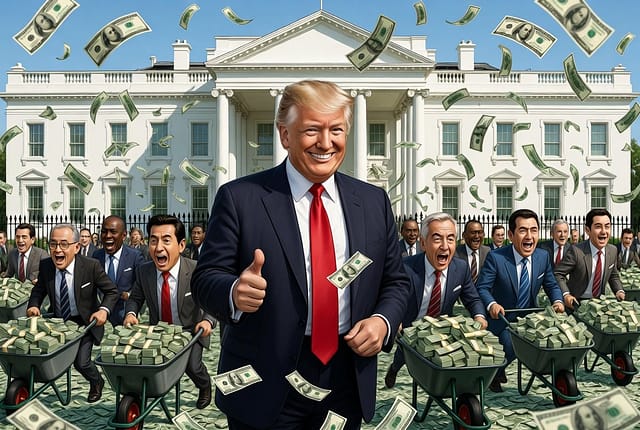
Almost every time he speaks, President Trump touts his unheard-of success in winning foreign investments since taking office. I think he started with the figure of $15 trillion, which rapidly escalated to $17 trillion, and most recently, to $19 trillion. Sometimes in the same oration, he will use conflicting figures, starting, for instance, with $17 trillion, and several sentences later, using the $19-trillion claim.
In fact, so far, there has been less than half a trillion in foreign investment since January 2025 and Trump’s inauguration. Actual investments by foreign entities total $285 billion in that period. Now, here comes the Trumpian “realistic hyperbole” part: pledged “American First” investments come in at $5 trillion. However, these are just pledges, not signed treaties or agreements. They may materialize or may not, especially following the Iran war and the many international enemies Trump has managed to create.
(NOTE: “Realistic hyperbole” is a term Trump introduces in his book, “The Art of the Deal.” It means to exaggerate realistic outcomes to win people to your cause. For instance: “My new hotel is projected to be at 90-percent accommodation levels within three months of opening.” (Trump being a builder of some fame and fortune.))
THE REALITY: Here’s the breakdown of what’s actually happening to that $19 trillion that Trump forecasts:
Since President Trump took office in January 2025, foreign investment metrics have split into two distinct categories: actual transactional flows tracked by federal agencies and political investment pledges negotiated under the administration’s “America First Investment Policy.”
The best available estimates for both show a massive spike in long-term commitments alongside a steady rise in baseline transactions.
- Actual Foreign Direct Investment (FDI) in 2025
According to preliminary statistics from the U.S. Bureau of Economic Analysis (BEA), official foreign direct investment rose significantly during the administration’s first year:
- First-Year Expenditures: Foreign investors spent $232.2 billion to acquire, establish, or expand U.S. businesses in 2025. This represents a 49.5% increase (up $76.8 billion) from 2024 levels.
- Acquisitions vs. New Businesses: The vast majority of actual capital went into acquiring existing U.S. operations ($218.4 billion), while greenfield expenditures (building new facilities or expanding footprint) accounted for $13.8 billion.
- Top Investing Countries: Japan led actual expenditures with $50.5 billion, followed by Germany ($26.7 billion) and Canada ($23.5 billion).
- Total Planned Outlays: Total planned spending for the deals initiated in 2025 (which factors in projected future-year spending for those specific projects) sits at $284.5 billion.
- Pledged Investment Under “America First” Policies
Separate from formal corporate transactions, the Trump administration has aggressively used trade leverage and tariff threats to extract massive, long-term political investment commitments from foreign governments.
According to data compiled by the Peterson Institute for International Economics (PIIE), total announced foreign investment pledges have surpassed $5 trillion:
| Country / Region | Estimated Pledge Amount | Key Details |
| Saudi Arabia | ~$1 trillion | Pledged by Crown Prince Mohammed bin Salman in November 2025. |
| Japan | $550 billion | Realignment deal signed in July 2025 targeting core American manufacturing. |
| Gulf Cooperation Council (GCC) | ~$4 trillion | Total combined target across Gulf states, including Saudi Arabia, Qatar, and the UAE. |
| Other Partners | Remainder of the $5T+ | Includes looser investment frameworks negotiated with the EU, South Korea, Taiwan, and Switzerland. |
The Catch on Pledges
Economic and legal analysts urge caution regarding the $5 trillion+ pledge baseline. Unlike the BEA’s hard data, these government-to-government commitments:
- Are largely non-binding executive agreements rather than formal treaties.
- Lack clear, transparent timelines or verification frameworks.
- Face deep skepticism from economists who point out that fulfilling $4 trillion from the Gulf states would heavily strain their sovereign wealth funds and conflict with their own domestic development goals.