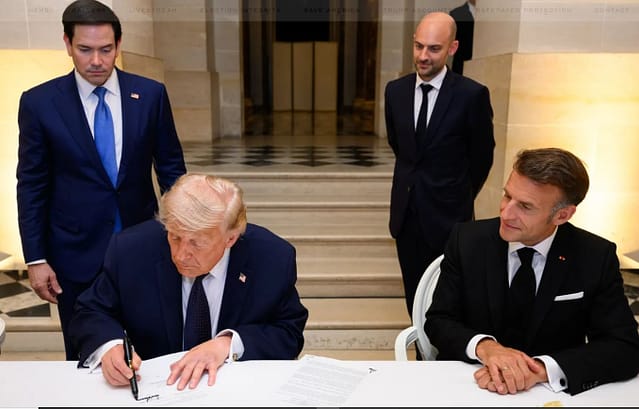
Cessation of Hostilities: Both nations agreed to an immediate end to military operations across all fronts, including in Lebanon, with mutual pledges to respect each other’s sovereignty.
Maritime Access and Blockades: Washington committed to lifting its naval blockade on Iranian ports within 30 days. In return, Tehran agreed to guarantee free and unhindered commercial shipping through the Strait of Hormuz for the full 60-day period.
Sanctions and Oil Waivers: The U.S. Treasury would issue immediate waivers on Iranian crude oil exports and related banking and insurance services, as a precursor to the complete dismantling of sanctions.
Negotiation Roadmap: Both sides committed to reaching a final deal within 60 days—one that would address Iran’s nuclear program, comprehensive sanctions relief, and a U.S.-led $300 billion regional economic reconstruction framework.
On paper, the MOU was ambitious. In practice, it began unraveling almost immediately.
A Timeline of Collapse
June 17, 2026 — Signing in Islamabad
U.S. and Iranian leadership remotely sign the 14-point memorandum following weeks of Pakistani and Qatari mediation. Both sides express cautious optimism about the 60-day negotiating window.
Late June 2026 — Disputes Over Implementation
Within days of signing, both parties are trading public accusations. Washington accused Tehran-backed forces of continuing regional strikes in violation of the cessation-of-hostilities clause. Tehran, for its part, claimed the United States had failed to lift maritime restrictions and naval blockades as required under the agreement’s 30-day timetable.
July 7, 2026 — MOU Declared Terminated
President Trump publicly declares the agreement nullified. The United States resumes targeted military strikes on sites inside Iran. Tehran responds by formally suspending its own commitments under the memorandum’s text.
July 8–24, 2026 — Renewed Military Strikes
U.S. forces conduct a series of bombing runs targeting Iranian infrastructure. Iran retaliates with missile and drone attacks against American military installations and assets in Jordan, Bahrain, and Kuwait, marking a significant escalation in the geographic scope of the conflict.
Early August 2026 — The Strait of Hormuz Impasse
Tensions migrate to the global energy corridor. President Trump threatens to declare the Strait of Hormuz “a territory of the U.S.,” a statement with sweeping implications for international shipping and energy markets. Tehran reaffirms its sovereign control over the waterway. Global fuel prices surge in response to the standoff.
August 16–17, 2026 — Deadline Expires
As the formal 60-day window closes, negotiations remain completely stalled. Iranian Foreign Minister Abbas Araghchi states that, because the United States violated the MOU weeks earlier, there is no active ceasefire left to extend. The agreement expires without a successor framework in place.
How an Agreement Unravels
The Islamabad Memorandum’s rapid disintegration followed a pattern familiar to fragile ceasefire arrangements: each side believed the other moved first.
Washington accused Tehran-aligned forces of exploiting the pause to continue striking regional targets, treating the MOU as a shield rather than a genuine commitment. Tehran countered that the United States had never honored its most concrete obligation—lifting the naval blockade on Iranian ports—making the agreement effectively void from the American side before Iran had any reason to hold its end.
Whether either accusation is fully accurate, the result was a self-reinforcing breakdown. Allegations of non-compliance gave each side political cover to resume hostilities, and the 60-day window—intended as a foundation for diplomacy—instead became the timeframe within which the ceasefire died.
The Strait of Hormuz dispute added another dimension. The waterway carries a substantial share of the world’s oil supply, and competing claims of sovereignty and control transformed what might have been a bilateral military standoff into a global economic concern. Rising fuel prices made the stakes of continued conflict visible to markets and governments far beyond the immediate parties.
Is Peace Still Possible?
The honest answer, based on the current situation, is: barely—but not impossibly.
The obstacles are formidable. The MOU has been declared dead by both sides. Renewed military strikes have deepened mutual distrust. The Strait of Hormuz standoff has introduced a new flashpoint with international dimensions. U.S. Treasury officials have signaled plans for what have been described as unprecedented economic sanctions against Iran, a move that would further harden Tehran’s position at any negotiating table.
Yet diplomatic channels have not been completely severed. Mediators from Pakistan and Qatar—the same parties whose patient groundwork produced the June agreement—are actively attempting to open a new framework for talks. Their continued engagement suggests that at least some regional actors believe a path forward remains viable.
The core issues that the MOU was meant to address—Iran’s nuclear program, comprehensive sanctions relief, and a potential $300 billion regional reconstruction framework—have not disappeared. If anything, the cost of continued conflict makes resolution more urgent, not less.
What a renewed framework would require is a more durable mechanism for verifying compliance, a sequencing of obligations that builds rather than immediately tests trust, and—critically—political will on both sides to treat a ceasefire as a genuine pause rather than a tactical opportunity.
Conclusion
The expiration of the Islamabad Memorandum on August 17 closes one chapter but does not necessarily end the story. The agreement was imperfect, contested almost from the moment of signing, and ultimately overwhelmed by the mutual suspicion it was supposed to help dispel. The renewed strikes, the Hormuz standoff, and the looming threat of expanded sanctions paint a bleak picture of where U.S.-Iranian relations now stand.
But the continued involvement of Pakistani and Qatari mediators represents the slimmest—and perhaps most important—remaining opening. Whether Washington and Tehran can be persuaded to return to a table they have both, in different ways, already walked away from remains the central unanswered question. The 60-day window is gone. The underlying conflict is not.