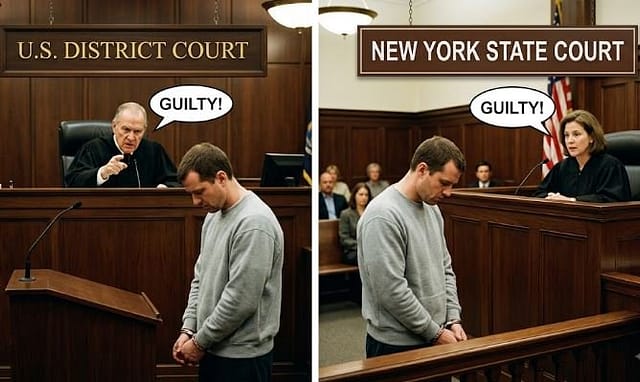
The U.S. Supreme Court reaffirmed this doctrine as recently as 2019, in Gamble v. United States, ruling that a conviction in state court does not automatically bar a subsequent federal prosecution — and vice versa. Applied straightforwardly to Mangione’s situation, the dual sovereignty doctrine would appear to leave New York free to proceed with its murder charges regardless of what happened in federal court.
But New York State does not stop there.
New York’s Stronger Shield
While federal constitutional law sets a floor for double jeopardy protections, states are free to go further — and New York has done exactly that.
Under New York Criminal Procedure Law § 40.20, the state prohibits prosecuting a defendant a second time for any offense arising out of the same criminal transaction, even when the prior prosecution took place in a different jurisdiction, such as federal court. This is a notably broader protection than the federal Constitution requires, and it is the centerpiece of Mangione’s defense strategy.
His legal team argues that because he has already been convicted in federal court — and admitted under oath during his guilty plea that he shot and killed Thompson — New York State is now legally barred from prosecuting him for second-degree murder and related weapons charges for the exact same act. In their view, CPL § 40.20 means what it says: one criminal transaction, one prosecution.
Why Prosecutors Aren’t Ready to Walk Away
The Manhattan District Attorney’s Office is fighting the motion to dismiss, and their argument centers on exceptions built into New York’s own statute.
New York law does permit successive prosecutions in certain circumstances — specifically, when the charges being brought carry substantially different legal elements and are designed to address fundamentally different kinds of harm. Prosecutors are expected to argue that the federal charges, which focused on interstate stalking resulting in death, and the state charges, which center on intentional murder and illegal possession of a weapon, are distinct enough under the law to qualify for that exception, even though both stem from the same shooting.
Mangione’s defense is likely to push back hard on that framing. His attorneys contend that the underlying conduct at the core of both cases is identical — the fatal shooting of Brian Thompson — and that allowing the state case to move forward would violate both the letter and the purpose of New York’s double jeopardy protections.
What Happens Next
The outcome of this legal dispute rests with the New York State Supreme Court judge assigned to the case. The judge will have to determine whether the state murder and weapons charges are sufficiently distinct from the federal stalking charge to clear the bar set by New York’s statutory exceptions — or whether the charges are, at their core, rooted in the same transaction and therefore barred under CPL § 40.20.
If the judge sides with the defense, the state murder case could be dismissed before it ever reaches trial. If the judge agrees with prosecutors that the charges address meaningfully different legal harms, Mangione could face a full state trial on top of his federal conviction.
Whether that trial happens will depend entirely on how the court reads New York’s law — a question that has no clear federal answer to fall back on.
This article is intended as a legal news analysis for informational purposes only and does not constitute legal advice.