That small change—swapping “estate” for “the pursuit of Happiness”—was genius. It made the concept universal, aspirational, and deeply human. Property is concrete and limited. Happiness is infinite and personal. Everyone, regardless of wealth, could claim that right.
The Document on His Desk
But Jefferson’s most immediate source wasn’t a dusty philosophical treatise. It was a brand-new document, still warm from the printer: George Mason’s Virginia Declaration of Rights, drafted just weeks earlier in May 1776.
Mason had been working on a declaration of rights for Virginia’s new state constitution, and his language was strikingly similar to what would appear in Jefferson’s draft. Mason wrote that all men have inherent rights to “the enjoyment of life and liberty, with the means of acquiring and possessing property, and pursuing and obtaining happiness and safety.”
Jefferson essentially took Mason’s blueprint for Virginia and scaled it up. What Mason had written for one colony, Jefferson transformed into a universal manifesto for all thirteen colonies—and, implicitly, for all of humanity. It was localized language elevated to cosmic principle.
Recycling His Own Work
Jefferson had another advantage: he’d been doing his homework. At the exact same time he was drafting the Declaration, he’d also been working on a proposed constitution for Virginia. That draft included a long, detailed list of grievances against King George III—specific complaints about taxes, trade restrictions, military occupation, and the dissolution of colonial legislatures.
When it came time to write the middle section of the Declaration—the part where the colonists needed to justify their break with Britain by documenting the king’s abuses—Jefferson simply copied from himself. Those 27 specific charges against the Crown? Most of them came straight from his Virginia constitution draft. Why reinvent the wheel when you’ve already catalogued the king’s offenses?
The Lawyer’s Structure
There’s one more influence worth noting: Jefferson’s legal training. He was a practicing lawyer, and it shows in the architecture of the Declaration. The document isn’t just a passionate manifesto. It’s structured like a legal brief presented to the court of world opinion:
- The Preamble establishes the universal principles—the legal and philosophical foundation for what’s to come.
- The Indictment presents 27 specific, concrete charges against King George III, each one a piece of evidence proving he violated the social contract.
- The Conclusion delivers the verdict: because the king broke the contract, the colonies are now “Free and Independent States.”
This wasn’t accidental. Jefferson was making a legal case for revolution, and he structured it the way any good lawyer would.
The Agony of Editing
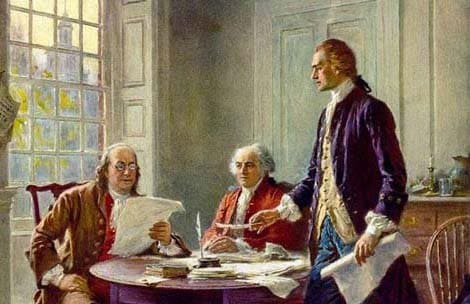
Jefferson didn’t work in complete isolation. He was part of a five-man committee appointed by the Continental Congress to draft the declaration. The committee included two other giants of the era: Benjamin Franklin and John Adams.
Once Jefferson finished what he called his “Original Rough Draft,” he nervously showed it to Franklin and Adams first. They made relatively few changes, but some were crucial. Historians believe it was Franklin—with his printer’s ear for language—who made one of the most important edits in American history.
Jefferson had originally written: “We hold these truths to be sacred & undeniable.”
Franklin changed it to: “We hold these truths to be self-evident.”
It seems like a small tweak, but it’s profound. “Sacred” appeals to religious authority. “Self-evident” appeals to reason and logic—the bedrock of Enlightenment thinking. Franklin’s edit shifted the Declaration’s foundation from divine revelation to rational truth, something that could be understood by anyone, anywhere, regardless of their faith.
With Franklin and Adams’s approval, the committee submitted the document to the full Continental Congress on June 28, 1776.
And then the real torture began.
Death by a Thousand Cuts
For Thomas Jefferson, the next several days must have felt like an eternity. Congress took his carefully crafted prose and tore into it. They debated. They argued. They cut.
By the time they were done, Congress had slashed roughly 25% of Jefferson’s original text.
Jefferson sat in the corner of the chamber, squirming silently as delegates dissected his words. He was notoriously thin-skinned about his writing, and watching Congress butcher his prose was agony. According to some accounts, Benjamin Franklin—sitting nearby and noticing Jefferson’s discomfort—tried to console him with a story about a sign-maker who kept revising his sign based on everyone’s suggestions until nothing was left but his name.
The most painful cut was also the most politically significant. Jefferson had included a long, passionate paragraph blaming King George III for the transatlantic slave trade. He accused the king of waging “cruel war against human nature itself” by forcing slavery on the colonies and then inciting enslaved people to rebel against their masters.
It was hypocritical, of course—Jefferson himself enslaved over 600 people during his lifetime—but it was also politically explosive. Southern delegates, whose economies depended on slavery, wanted it gone. Northern merchants involved in the slave trade weren’t eager to be reminded of their complicity either.
Congress struck the entire passage.
Jefferson never quite got over it. Years later, he was still complaining about the deletions, insisting that his original version was superior. He kept copies of his draft and would show them to visitors, pointing out what Congress had removed.
The Document That Changed the World
But here’s the irony: the collaborative editing process, as painful as it was for Jefferson, probably made the Declaration better.
Congress’s cuts tightened the prose. They removed some of Jefferson’s more flowery language and sharpened the focus. The deleted slave trade passage, while morally significant, was also logically inconsistent and would have undermined the document’s credibility. The final version was leaner, clearer, and more powerful.
On July 4, 1776, Congress approved the final text. The Declaration of Independence wasn’t just Jefferson’s work—it was the product of committee refinement and congressional debate. It was, in the truest sense, a collaborative expression of the American mind.
Jefferson’s 17 days in that Philadelphia room, armed with his portable writing desk and his mental library of Enlightenment philosophy, produced the first draft. But it took Franklin’s editorial precision, Adams’s political judgment, and Congress’s collective wisdom (and ruthlessness) to forge it into the document we know today.
The young man who sat uncomfortably in the corner, watching his words get cut, couldn’t have known that his edited, revised, and collaboratively improved declaration would become one of the most consequential pieces of political writing in human history. Its words would inspire revolutions on multiple continents. Its principles would be invoked by abolitionists, suffragists, civil rights leaders, and freedom movements around the globe.
Not bad for 17 days’ work in a rented room.