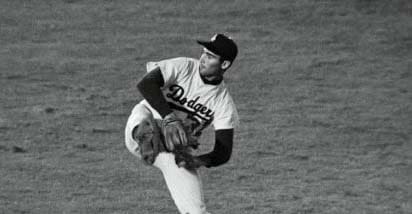
Dodger pitching legend Sandy Koufax, now 90 and rightfully ensconced in the MLB Hall of Fame, was known for his blazing fastball during his prime in the 1950s and 1960s. When I watched him on TV as a kid — he was my idol — that fastball seemed to clock in at supersonic speeds.
After one World Series game against the Yankees, the Bronx Bombers’ catcher, Yogi Bera, opined: “I can see how he won 25 games. What I don’t understand is how he lost five.”
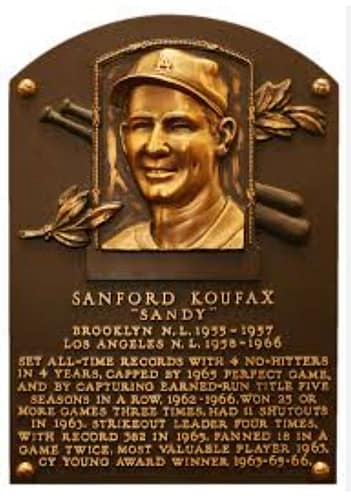 Musing on the current baseball season today got me thinking of Koufax and wondering how fast his fastball really was and how well it would fare against today’s 100-mph version.
Short answer: His fastball clocked in about 93-94 mph, according to best estimates since no radar guns were used back then to measure speeds. Speed-wise, then, Koufax would have an average fastball today. However — a big however — Koufax mastered spin rate, so that his fastball looked to be rising as it reached the plate, and batters couldn’t adjust.
Don’t take my word for it: I had my AI pal Gemini research the topic for me, and here are the results and detailed explanation:
Comparing Sandy Koufax’s legendary fastball to the heaters thrown in today’s game requires translating raw velocity across different eras and looking closely at the pitch’s physics — specifically its spin and “ride.”
If you dropped 1960s Koufax onto a modern Major League mound, his fastball would still be an elite weapon, but the way it challenges hitters would look a bit different.
- The Velocity Translation (93 mph vs. 100+ mph)
During his peak (1961–1966), Koufax was widely considered the hardest-throwing lefty in baseball.
- The “Eye Test” Era: Radar guns didn’t exist in the modern sense. To the hitters of the 1960s, Koufax’s fastball felt like 100 mph.
- The Modern Adjustment: Historical sports physicists and data analysts estimate Koufax’s true, consistent velocity sat around 92 to 94 mph, occasionally dialing it up to 97 or 98 mph when he needed a strikeout.
By today’s standards, a 93-mph average fastball from a left-handed starter is respectable but completely normal. In today’s game, the average MLB fastball sits around 94–95 mph, with relief pitchers and elite starters regularly reaching 98 to 102 mph.
- The Illusion of the “Rising” Fastball (Spin Rate)
While Koufax might lack the top-end velocity of modern pitchers, his fastball possessed a characteristic that modern analytics engines crave: an exceptionally high spin rate.
Hitters from his era constantly swore that Koufax’s fastball “rose” as it neared the plate. While physics prevents a baseball thrown overhand from actually rising against gravity, a high backspin rate creates Magnus lift. This lift fights gravity, causing the ball to drop significantly less than a hitter’s brain expects.
The Result: Hitters consistently swung underneath Koufax’s fastball because it stayed higher in the zone than normal pitches.
Koufax achieved this through a unique, extreme over-the-top mechanics package. He threw from a completely vertical arm slot, driving his body downward with a massive stride that let him release the ball closer to the plate (increasing his perceived velocity). Modern pitchers use tech like Rapsodo to engineer this exact “induced vertical break,” but Koufax did it naturally.
- Stamina and Context
The biggest differentiator isn’t the pitch itself, but how often and how long he threw it. Today’s pitchers throw with maximum, violent effort for 5 to 6 innings (around 85–100 pitches) before handing the game to a high-velocity bullpen.
Koufax was a workhorse. In 1965, he threw 335.2 innings and pitched 27 complete games. He threw his exploding fastball and his devastating “12-to-6” curveball over and over again, often throwing 130+ pitches a night, and his velocity rarely dipped in the 9th inning.
The Verdict
If 1965 Koufax stepped into a modern game with no adjustments, his fastball would look like a modern “ride-and-run” four-seamer with elite vertical movement — similar to the fastballs of pitchers like Justin Verlander or Josh Hader, relying on deception and late life in the upper zone rather than pure, unadulterated speed.
However, if Koufax were brought up in today’s sports-science environment — with modern weight training, biomechanical optimization, and analytics — his natural physical gifts suggest he would easily be sitting at 98–100 mph with modern spin rates.