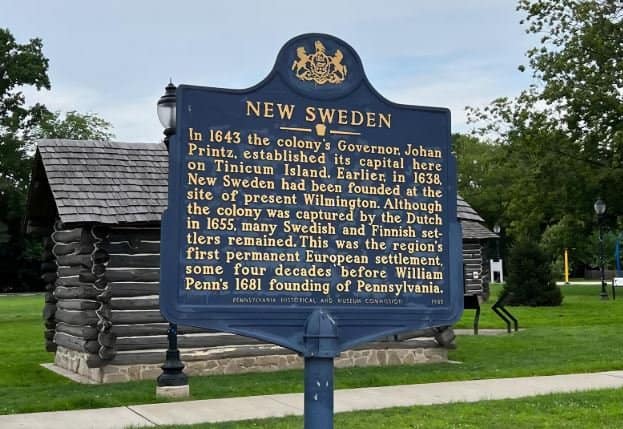
How many visitors to Philadelphia during America’s 250th Anniversary will realize that it was once Swedish? Here’s the story about how a “Small Colony Helped Build a Great Nation” that will provide some context to the development of American civilization, beginning with the introduction of the log cabin and peaceful interactions with the Native Indian Tribes.
How 17 Years and 600 Settlers Shaped a Nation’s Character
As America celebrates its 250th anniversary, we naturally turn our gaze to the familiar landmarks of our founding: Philadelphia’s Independence Hall, Boston’s harbor, Virginia’s plantations. But woven into the fabric of our national story are quieter threads—brief experiments that burned brightly and left permanent marks on the American character.
New Sweden, a tiny Scandinavian colony that existed for just 17 years along the Delaware River, is one of those essential threads. Though it never grew beyond 600 souls, this remarkable settlement pioneered the peaceful coexistence, innovative spirit, and multicultural cooperation that would become hallmarks of the American experiment. From the log cabins that symbolize frontier independence to the very boundaries of Delaware and Pennsylvania, New Sweden’s legacy surrounds us still—hidden in plain sight, waiting to be celebrated.
A Northern Power’s Bold Vision
In the 1630s, Sweden stood as one of Europe’s great military powers. Under the brilliant King Gustavus Adolphus—the “Lion of the North”—Swedish armies had reshaped the map of Europe during the Thirty Years’ War. When Gustavus Adolphus fell in battle in 1632, his six-year-old daughter Christina inherited not just a throne, but an empire with global ambitions. Sweden’s forests produced the finest timber and iron in Europe; its merchants hungely eyed the lucrative tobacco and fur trades that were enriching the Dutch, English, and French. Why shouldn’t Sweden claim its share of the New World’s bounty?
The Swedish crown chartered the New Sweden Company with a mission both commercial and visionary: establish a foothold in North America that could serve as a gateway to wealth while extending Swedish influence across the Atlantic. In a stroke of ironic genius, they hired Peter Minuit to lead the expedition—the very same Dutch administrator who had famously purchased Manhattan Island for the Dutch West India Company just twelve years earlier. Minuit knew the region, understood indigenous diplomacy, and possessed the practical experience that armchair colonizers lacked. If anyone could plant Sweden’s flag in the New World, it was this seasoned colonial veteran.
The Landing: March 1638
Picture the scene: two Swedish vessels, the Fogel Grip (Griffin) and Kalmar Nyckel (Key of Kalmar), sailing into Delaware Bay on a cold March morning in 1638. Aboard were Swedish soldiers, Finnish farmers, Dutch merchants, and German craftsmen—a multicultural crew united by Swedish leadership and a shared hunger for new beginnings. The ships carried not just people but seeds, livestock, tools, and the building traditions of the Baltic forests.
Peter Minuit understood something that many European colonizers did not: sustainable settlement required indigenous cooperation, not conquest. He approached the Lenape people—the original inhabitants of the Delaware River valley—not with ultimatums but with respect. Through careful negotiation and fair exchange, Minuit purchased land rights from the Lenape sachems. On the site of present-day Wilmington, Delaware, the settlers raised Fort Christina, naming it for Sweden’s young queen. The fort’s palisade walls enclosed a trading post, a church, and homes—the seed from which a new society would grow.
What made this founding moment remarkable wasn’t just the peaceful land purchase, but the relationship it established. The Swedes and Finns arrived without overwhelming military force. They numbered in the dozens, not thousands. Survival depended on cooperation with the Lenape and neighboring Susquehannock nations, and cooperation is precisely what they achieved. Unlike the violent clashes that marked so many colonial ventures, New Sweden’s borders remained largely peaceful throughout its existence.
Building a Baltic Community in America
The settlers who disembarked at Fort Christina brought with them centuries of Scandinavian and Finnish forest wisdom. Many were Forest Finns—people from Finland’s dense woodlands who had lived under Swedish rule and now sought new opportunities across the Atlantic. These Forest Finns possessed knowledge that proved invaluable in the heavily forested Delaware Valley: svedjebruk, the practice of slash-and-burn clearing that could transform seemingly impenetrable woodland into productive farmland. While other colonists struggled with America’s thick forests, the Finns saw familiar terrain and knew exactly how to tame it.
But the Finns and Swedes brought something even more transformative: the log cabin. In the Baltic regions, builders had perfected knuttimring—corner-notched log construction that required no nails, created sturdy walls, and could be erected quickly using raw timber. A skilled crew could raise a log cabin in days, creating weatherproof shelter that would last generations. This building technique, so perfectly suited to a forested frontier, would become the iconic symbol of American pioneer life. Every log cabin that later dotted the Appalachian frontier, every Lincoln-esque “born in a log cabin” origin story, traces its lineage back to those Swedish and Finnish settlers on the Delaware River.
Governor Printz and the Golden Years
In 1643, New Sweden received a leader who would define its peak years: Johan Björnsson Printz, a massive man—reportedly over 400 pounds—with an equally outsized personality and administrative talent. Governor Printz arrived with clear instructions: expand the colony, secure the fur trade, and make New Sweden profitable for the crown.
Printz proved brilliantly effective. He moved the colonial capital upstream to Tinicum Island, near present-day Philadelphia, where he built an impressive manor house called Printzhof. From this strategic location, he controlled river traffic and established a near-monopoly on the regional fur trade. Swedish traders developed deep relationships with indigenous trappers, learning the waterways, understanding seasonal patterns, and building the trust necessary for sustained commerce. The furs that flowed down the Delaware to Swedish ships—beaver, otter, mink—found eager markets in Europe, finally delivering the profits that the New Sweden Company had promised its investors.
Under Printz’s decade-long governorship (1643-1653), the colony expanded to perhaps 600 residents spread across farms, trading posts, and small settlements from modern Delaware through New Jersey and into Pennsylvania. Swedish and Finnish families cleared land, planted crops, raised livestock, and built churches where Lutheran ministers conducted services in multiple languages. The colony remained small by design—Sweden lacked the population surplus of England or the commercial resources of the Dutch—but it was stable, profitable, and peacefully integrated into the regional indigenous trade networks.
The Art of Peaceful Coexistence
What distinguished New Sweden from so many contemporary colonial ventures was its remarkable commitment to peaceful diplomacy with indigenous peoples. This wasn’t merely pragmatic necessity—though the colony’s small size certainly encouraged cooperation—but reflected a genuine effort at mutual understanding that was rare in the 17th century.
Consider Johannes Campanius, a Lutheran minister who arrived in New Sweden in 1643. Rather than simply preaching to Swedish settlers, Campanius undertook the painstaking work of learning the Lenape language. He compiled a Lenape vocabulary, studied the language’s grammar and structure, and ultimately translated the Lutheran Catechism into Lenape—one of the earliest examples of European religious texts rendered in a North American indigenous language. Campanius’s linguistic work wasn’t just about conversion; it represented a bridge between cultures, an acknowledgment that meaningful relationship required speaking the other’s language, literally and figuratively.
Swedish settlers regularly traded with, learned from, and lived alongside Lenape and Susquehannock neighbors. Intermarriage occurred. Swedish farmers adopted indigenous agricultural techniques; indigenous hunters acquired Swedish metal tools. The archaeological record shows Swedish and indigenous artifacts intermingled at settlement sites, evidence of daily interaction and exchange. When conflicts arose—as they inevitably did in any multicultural frontier—they were typically resolved through negotiation rather than violence.
This peaceful coexistence stands in stark contrast to the bloody conflicts that characterized so many other colonial ventures. While Virginia fought devastating wars with the Powhatan Confederacy, while New England erupted in King Philip’s War, the Delaware Valley remained largely peaceful. New Sweden demonstrated that European settlement and indigenous sovereignty could coexist—a lesson that tragically went unheeded in later American expansion, but one that deserves recognition in our national story.
September 1655: The End of Independence
All colonial ventures existed within larger imperial competitions, and New Sweden’s location placed it squarely in disputed territory. The Dutch had established New Netherland to the north, with its capital at New Amsterdam (Manhattan) and trading posts throughout the Hudson and Delaware valleys. From the Dutch perspective, New Sweden was an illegal encroachment on their territorial claims—a Swedish wedge driven into Dutch America.
In September 1655, Director-General Peter Stuyvesant—the peg-legged, iron-willed leader of New Netherland—decided to resolve the Swedish problem permanently. He assembled an overwhelming force: seven armed ships carrying hundreds of soldiers. This armada sailed up the Delaware River toward the Swedish forts, a show of force that made resistance futile.
The Swedish garrison at Fort Christina, outnumbered and outgunned, surrendered without bloodshed. Governor Johan Rising, who had replaced Printz, negotiated terms that allowed Swedish settlers to remain on their farms, keep their property, and practice their Lutheran faith. New Sweden as an independent political entity ceased to exist after just 17 years, absorbed into Dutch New Netherland.
Yet this “conquest” proved remarkably gentle. The Dutch had no interest in displacing productive farmers and skilled traders. Swedish and Finnish families stayed on their land. Their churches remained open. Their language continued in homes and communities. When the English conquered New Netherland just nine years later in 1664, renaming it New York, the Swedish settlements again survived the transition intact. Political sovereignty changed hands, but the Swedish and Finnish communities endured.
Legacy: Small Colony, Enormous Impact
New Sweden’s brief political existence belies its profound and lasting impact on American development. Its legacy manifests in multiple dimensions—architectural, diplomatic, political, and cultural—that shaped the Mid-Atlantic region and, through it, the broader American experience.
The Log Cabin: An Architectural Revolution
The log cabin’s journey from Swedish-Finnish building technique to quintessential American symbol represents one of history’s great cultural transmissions. As the frontier pushed westward through Pennsylvania, across the Appalachians, and into the Ohio Valley, Kentucky, and beyond, the log cabin went with it. Scots-Irish, German, and English settlers adopted and adapted the technique, recognizing its perfect suitability for forested frontier conditions.
By the 19th century, the log cabin had become mythologized as the birthplace of American democracy—the humble origin from which self-made men rose to greatness. Seven U.S. presidents claimed log cabin births, most famously Abraham Lincoln. The 1840 “Log Cabin Campaign” of William Henry Harrison weaponized the log cabin as a symbol of frontier authenticity against elite privilege. That this iconic American symbol originated with Swedish and Finnish settlers in the 1630s is a testament to New Sweden’s hidden but profound influence on American material culture and national mythology.
Seeding Pennsylvania and Delaware
When William Penn arrived in 1682 to establish his “Holy Experiment” of religious tolerance and peaceful settlement, he didn’t find wilderness—he found a functioning society. Swedish and Finnish farms dotted the landscape. Lutheran churches served established congregations. Swedish magistrates administered local justice. Swedish traders maintained relationships with indigenous nations.
Penn, a pragmatic visionary, embraced this Swedish inheritance. He hired Swedish settlers as translators and intermediaries with the Lenape. He appointed Swedes to positions in his new government, recognizing their experience and local knowledge. The Swedish community welcomed Penn’s Quakers, seeing in them kindred spirits committed to peaceful coexistence and religious freedom.
The geographic legacy proved equally significant. New Sweden’s settlements had established a distinct region along the lower Delaware—the “Three Lower Counties” that would eventually separate from Pennsylvania to become the state of Delaware. Delaware’s unique identity, its small size, and its early importance in American history all trace back to the boundaries and communities established by New Sweden.
A Multicultural Model
New Sweden was never purely Swedish. From its founding, the colony included Finns, Dutch, Germans, and others. This multicultural character—unusual for 17th-century colonial ventures—prefigured America’s eventual identity as a nation of immigrants. The Swedish crown’s willingness to recruit settlers regardless of ethnicity, the colony’s practical multilingualism, and its integration of diverse European traditions created a template for the pluralistic society that would emerge in Pennsylvania and spread across America.
The Forest Finns deserve particular recognition. These people, often marginalized in European society, found in New Sweden an opportunity to apply their specialized knowledge and thrive. Their agricultural innovations—particularly slash-and-burn clearing techniques—enabled settlement of heavily forested areas that other colonists avoided. Finnish families became prosperous farmers, their descendants spreading throughout the Delaware Valley and beyond, carrying Finnish surnames and traditions into the American mainstream.
Continuity Through Conquest
Perhaps most remarkably, the Swedish and Finnish communities maintained their distinct identity for generations after New Sweden’s political demise. Swedish remained a spoken language in Delaware Valley churches and homes well into the 18th century. The Swedish Lutheran churches—Gloria Dei (Old Swedes’) Church in Philadelphia, Holy Trinity (Old Swedes) Church in Wilmington—continued serving their congregations and still stand today as living monuments to New Sweden’s legacy.
Swedish and Finnish surnames—Rambo, Yocum, Keen, Justis, Stedham—became woven into the American tapestry. These families served in colonial assemblies, fought in the Revolution, and helped build the new nation. The continuity of community across political transitions demonstrated that cultural identity could survive and thrive even when political sovereignty changed hands—a lesson relevant to America’s multicultural present.
New Sweden and American Identity
As we celebrate America’s 250th anniversary, New Sweden offers a compelling counter-narrative to the dominant stories of colonial America. It reminds us that the American experiment wasn’t solely English, that peaceful coexistence with indigenous peoples was possible, and that small communities could have outsized impacts on national development.
New Sweden embodied values we recognize as fundamentally American: innovation and adaptation (the log cabin), peaceful diplomacy (relations with the Lenape), religious freedom (Lutheran churches thriving under Dutch and English rule), multiculturalism (Swedish, Finnish, Dutch, and German settlers cooperating), and practical cooperation over ideological rigidity.
The colony’s brief existence—just 17 years—reminds us that historical impact isn’t measured solely in longevity or size. Those 600 Swedish and Finnish settlers, in less than two decades, introduced architectural techniques, diplomatic practices, and cultural traditions that shaped American development for centuries. They demonstrated that a small group of determined people, committed to cooperation rather than conquest, could plant seeds that would grow into forests.
Today, as we walk past log cabins in historical parks, cross the Delaware River between Pennsylvania and Delaware, or trace Swedish surnames in genealogical records, we encounter New Sweden’s legacy. It’s a legacy often overlooked in textbooks focused on Jamestown, Plymouth, and Boston, but it’s no less essential to understanding how America became America.
New Sweden teaches us that our national story is richer and more complex than any single narrative can capture. It reminds us that cooperation, innovation, and peaceful coexistence aren’t just modern aspirations but historical realities that helped build this nation. And it challenges us to look beyond the familiar landmarks of American history to discover the hidden threads—the brief experiments, the small communities, the overlooked pioneers—that wove together to create the diverse, dynamic, enduring fabric of American democracy.
In celebrating America’s 250 years, we celebrate not just the nation that declared independence in 1776, but the centuries of experimentation, cooperation, and cultural exchange that made that independence possible. New Sweden, though it ended 121 years before the Declaration of Independence, belongs in that celebration—a small colony that helped build America big.