Richard III
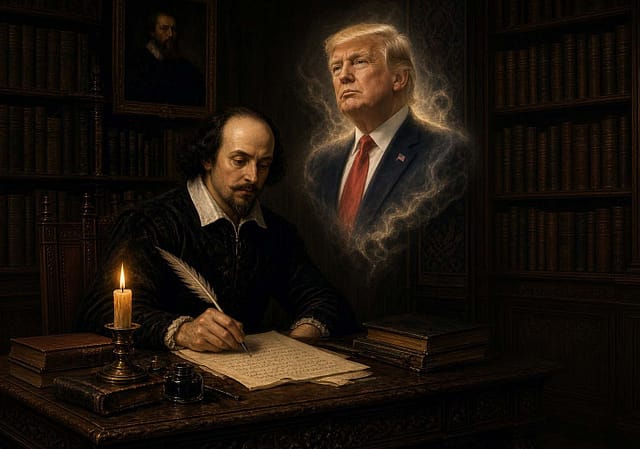
The strongest and most frequently cited parallel is Richard III, the Machiavellian schemer of Shakespeare’s early history play. Richard is a consummate outsider who seizes power not through inherited legitimacy or institutional support but through unconventional tactics: charismatic direct address, calculated grievance, and a willingness to violate every established political norm standing between him and the throne.
What makes the comparison especially apt is Richard’s mode of self-presentation. He famously introduces himself to the audience as a “plain, blunt man,” a self-deprecating claim that is itself a rhetorical performance—Richard is anything but plain or blunt in the conventional sense. Critics have noted that this kind of theatrical authenticity, where a leader insists on his own candor while manipulating the emotional register of his audience, echoes Trump’s rhetorical style. Both figures thrive on direct, unmediated address; both use populist grievance and the language of victimhood to erode the credibility of political rivals; and both derive power less from institutional position than from sheer performative force.
Coriolanus
Shakespeare’s Coriolanus offers a different but related parallel: a proud, uncompromising military leader with deep contempt for the rituals of civilian politics. Coriolanus refuses to flatter the Roman citizenry, views political compromise as beneath him, and positions himself as a singular, indispensable figure whose value lies outside ordinary democratic norms.
Commentators have drawn on this dynamic to describe Trump’s relationship with political elites and institutional convention. Like Coriolanus, Trump has often been characterized as impatient with established decorum, reliant on personal loyalty rather than institutional process, and prone to intense, even volcanic reactions when rejected or challenged by the public or the press. Coriolanus’s tragic arc—his banishment and subsequent turn against Rome itself—also offers commentators a cautionary frame for thinking about leaders who define themselves in opposition to the political establishment they once sought to lead.
King Lear
King Lear provides a somewhat different lens, focused less on the acquisition of power than on its exercise within an inner circle. Lear, an aging monarch, famously demands a public performance of love and loyalty from his daughters as a precondition for dividing his kingdom—a test that proves disastrous when interpreted too literally or too cynically.
Analysts drawing this comparison point to patterns of leadership within Trump’s family and advisory circles: an emphasis on personal loyalty over institutional role, the distribution of authority among family members and close confidants, and a tendency to turn sharply against former allies perceived as insufficiently devoted. The Lear comparison is less about the acquisition of power than about its erratic administration—the volatility that can result when governance is organized around personal fealty rather than formal structure.
Falstaff
A markedly different, more comic parallel comes from Sir John Falstaff, the boastful, rule-flouting companion of Prince Hal in Shakespeare’s Henry IV plays. Falstaff is larger than life: a figure of bombast, exaggeration, and cheerful disregard for convention, who nonetheless commands genuine affection and charisma.
This comparison surfaced frequently among commentators during the 2016 campaign, who noted a shared talent for absorbing criticism and controversy without lasting political damage—deflecting scandal through humor, bravado, and sheer performative confidence. Where more conventional politicians might be derailed by gaffes or controversy, both Falstaff and, in this reading, Trump seem to metabolize such moments into further spectacle, sustaining their appeal through raw charisma rather than polish or restraint.
Julius Caesar
Finally, Julius Caesar has become one of the most visible touchpoints for this discussion, largely because of a specific real-world event: the Public Theater’s 2017 Shakespeare in the Park production, which staged Caesar’s assassination with a Caesar visually modeled on Trump. The production generated significant public controversy and drew renewed attention to the play’s central tension—a populist leader who commands the passionate loyalty of the masses, set against an anxious political establishment that fears his ascendance threatens the republic’s institutional foundations.
The Caesar comparison foregrounds this specific dynamic: the friction between a charismatic strongman and the elites who see him as an existential threat to democratic norms, regardless of his personal fate. It says less about individual temperament than about the structural anxieties his rise provokes among established political actors.
Conclusion
Taken together, these five comparisons illuminate different dimensions of a single, complicated public figure: Coriolanus captures the disdain for political convention; Lear, the demand for loyalty within an inner circle; Falstaff, the comic resilience and charisma; and Caesar, the structural anxiety of elite institutions confronting populist power. Yet Richard III remains the most complete and frequently cited match, precisely because it unites so many of these threads—the outsider’s disruption of norms, the theatrical self-fashioning, the populist appeal to grievance, and the calculated use of direct address to bypass institutional gatekeepers.
Still, any such comparison has real limits. Shakespeare’s characters are literary constructions, shaped by dramatic necessity and the political concerns of Elizabethan and Jacobean England, not empirical descriptions of any twenty-first-century leader. These parallels are best understood as interpretive tools—ways of thinking through political style and public perception—rather than as claims about psychological truth. What they demonstrate, above all, is the remarkable durability of Shakespeare’s insight into the mechanics of power: four centuries later, his characters still offer a vocabulary for describing the leaders who dominate our own political stage.