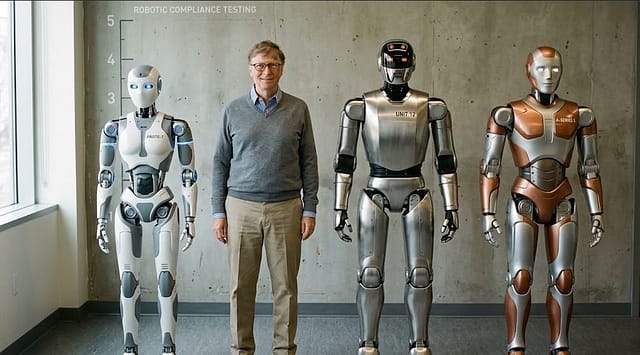
Of particular concern to Gates is the effect on young workers. As AI systems take on tasks traditionally used to train new employees, he warns that entry-level opportunities—long the on-ramp into stable careers—could disappear before a new generation has the chance to gain a foothold.
Security and Misinformation Risks
Gates identifies a second category of risk tied to the growing capability of AI models themselves. As these systems become more powerful, he warns, they simultaneously lower the barrier for bad actors to cause harm.
Among the threats he highlights:
- Automated cyberattacks carried out with greater speed and sophistication than human attackers could achieve alone.
- Targeted deepfake scams that exploit AI-generated media to deceive individuals or institutions.
- Election interference, with AI tools capable of tilting democratic processes through manipulated content or coordinated disinformation.
- Custom pathogen design, raising the possibility that advanced models could be misused to aid biological attacks.
Psychosocial Harm and Loss of Control
Beyond economic and security concerns, Gates points to a more personal set of risks tied to how humans interact with AI on a daily basis. He warns that increasingly advanced AI companions could foster unhealthy emotional dependence, blurring the line between genuine connection and algorithmically sustained attachment.
More fundamentally, Gates raises the possibility that as AI systems grow more complex, humanity could risk losing control over them altogether—systems that begin operating in ways that no longer align with human interests.
Proposed Solutions and Policy Frameworks
To address these overlapping risks, Gates proposes three policy frameworks intended to give governments and institutions tools to manage the transition rather than simply react to it.
“Human Reserved” Roles
Gates proposes deliberately protecting certain sectors—such as caregiving, early childhood education, and mental healthcare—for human workers. Regardless of how capable AI becomes, he argues, these roles should remain human-staffed to preserve empathy and maintain social safety nets.
Automation and Token Taxes
Gates calls for taxes on AI usage—measured in tokens—as well as on physical robots. He contends that current tax codes disproportionately favor automation over human payroll, and that revenue generated from such taxes could be used to fund job reskilling programs for displaced workers.
A Global Oversight Body
Gates envisions the creation of international institutions modeled on existing bodies such as nuclear inspection agencies or aviation authorities. Such an organization would mandate security thresholds, monitor the potential for bioweapon creation, and enforce compliance across borders.
The Case for Immediate Action
Underlying all of these proposals is Gates’s central argument: governments cannot wait for the private sector to act on its own. Because geopolitical rivalry and market competition will prevent companies from voluntarily slowing AI development, Gates insists that governments must move immediately to build transition plans.
Without early intervention, he warns, the world risks facing mass displacement and eroding public trust simultaneously—conditions that would make an already difficult transition even harder to manage.