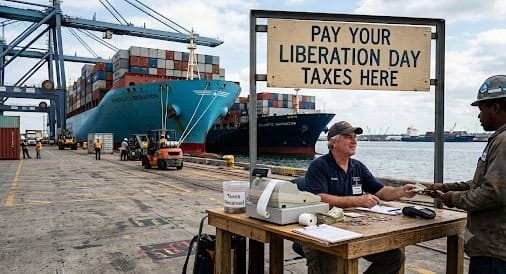
The refund mechanism itself has created a procedural nightmare. Over 330,000 importers who paid duties on more than 53 million shipments are now navigating a complex claims process through the Customs and Border Protection’s CAPE electronic refund system. However, the relief is highly uneven. Major corporations like Apple have reportedly received $2.2 billion in refunds, Amazon $600 million, and Nike $300 million, while smaller importers face significant obstacles in accessing their refunds, with some filing class-action lawsuits against the government.
Consumer Inflation: Where Tariffs Still Bite
Despite the Supreme Court ruling and massive refunds flowing to importers, American consumers have seen virtually no relief from tariff-driven price increases. The economic transmission mechanism has proven stubbornly asymmetric: businesses passed tariff costs to consumers rapidly when duties were imposed, but they show little inclination to lower prices now that those costs have been partially refunded.
Goldman Sachs economists have documented this “price rigidity” effect, estimating that tariffs implemented through November 2025 raised core goods prices in the Personal Consumption Expenditures index by approximately 3.1 percent through February 2026. A Federal Reserve analysis confirmed a nearly “dollar-for-dollar” pass-through: when tariffs raised retailer costs, consumer prices rose by roughly the same amount.
The Tax Foundation estimates that the tariffs cost the average American household approximately $1,000 in 2025 alone. Even after the Supreme Court ruling, with the administration pivoting to impose new tariffs under different legal authorities—including a 15 percent global import tariff under Section 122 of the Trade Act of 1974—Yale University’s Budget Lab projects that tariffs will still add $600 to $800 to the average consumer’s annual expenses. As one struggling California grandmother told reporters, her monthly expenses have shot up from $2,300 to over $2,500, leaving her unable to make ends meet despite careful budgeting.
The administration’s proposal to provide $2,000 tariff refund checks to consumers never materialized, leaving households to bear the burden without compensation. Treasury Secretary Scott Bessent himself acknowledged that consumers are “unlikely” to see any of the refunded money, noting that the legal process could drag on for weeks, months, or even years.
Supply Chain Pressures and Material Shortages
Beyond the fiscal and consumer impacts, the post-ruling tariff regime has created targeted supply chain disruptions that threaten critical industries. In August 2026, President Trump signed an executive order imposing a 15 percent tariff on polysilicon imports—a key material for solar panels and semiconductors—along with minimum import prices of $21 per kilogram for polysilicon and $100 per kilogram for polysilicon ingots and wafers. This move, justified under Section 232 of the Trade Expansion Act on national security grounds, reflects the administration’s determination to continue tariff policy through alternative legal channels.
These measures come at a time when U.S. domestic polysilicon production capacity has collapsed from 50 percent of global capacity in 2005 to less than 2 percent in 2024. The disconnect between policy goals and domestic capability is stark: while the administration hopes to encourage domestic production through a “Reshore America” program offering tariff exemptions for qualifying facility investments, the immediate effect is likely to increase costs for solar panel manufacturers and semiconductor producers already struggling with supply chain constraints.
The broader trade policy uncertainty has become chronic rather than episodic. The Trade Policy Uncertainty Index has remained persistently elevated, with tariffs triggering what experts describe as a chain reaction of defensive and offensive maneuvers by both states and corporations. This uncertainty, combined with the more than 50 tariff changes implemented in just 18 months, has created a toxic environment for long-term business planning, discouraging investment and distorting pricing decisions.
Conclusion
The “Liberation Day” tariffs and their aftermath represent a cautionary tale in economic policy. The Supreme Court’s rebuke created a bizarre fiscal scenario in which the government is now losing money on tariff operations while consumers continue to pay elevated prices and critical industries face new shortages. The refund process has benefited large corporations disproportionately while doing nothing for the households that bore the costs.
The administration’s determination to pursue tariff policies through alternative legal authorities ensures that economic uncertainty and inflationary pressure will persist. As the Tax Foundation noted, the confusion and chaos of the tariff regime may ultimately cause more economic damage than the tariffs themselves—and unlike the tariffs, that damage cannot be refunded.