The phrase, “separation of church and state,” has always been treated by liberals and their cohorts in the media as a sort of Constitutional gospel, but the phrase never appears in the U.S. Constitution. What the Constitution says in the First Amendment is that “Congress shall make no law respecting an establishment of religion, or prohibiting the free exercise thereof…. ” In other words, there can be no national religion and people are free to choose whatever religion they like.
The phrase about “separation of church and state” is derived from a letter written by Thomas Jefferson, author of the Declaration of Independence and the nation’s third president. It does not appear in the Constitution. Instead, Jefferson’s 1802 letter to the Danbury Baptist Association describes the First Amendment as building a “wall of separation between Church & State.”
That Jeffersonian phrase is essential to what President Trump’s Religious Liberty Commission determined in finalizing its report, which was presented to Trump today. The report talks about building “bridges, not walls, between the City of God and the City of Man.” It concludes that a wall indeed has been built because of authoritarian abuse of the Jefferson-derived phrase.
The report contains 12 recommendations, one of which is to remove the so-called Johnson Amendment, a 1954 provision in the U.S. tax code that prohibits all 501(c)(3) nonprofits — including churches, charities, and educational institutions — from endorsing or opposing political candidates. Other recommendations include setting up hotlines to report abuses of religious liberty.
Commission Vice-Chair Dan Patrick, lieutenant governor of Texas, claimed in remarks that the phrase “separation of church and state” has been used by the political left “to batter and hammer people of faith for the last 70 to 80 years.”
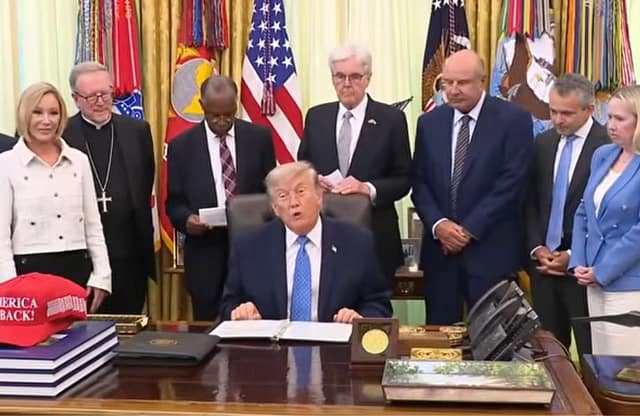
Patrick said, during a White House ceremony (pictured above) held to release the report, that if you’re denied your rights by someone citing “separation of church and state,” ask them to show where that phrase exists in the Constitution. This was echoed by Bishop Robert Barron of Winona-Rochester, a Commission member.
Because the language is not in the Constitution, Barron said, “donʼt be cowed” by the claims of “separation of church and state, a wall of separation, therefore, retreat into silence, retreat into privacy with your religion. I say, no, donʼt buy that.”
Good luck telling that to your boss who says you can’t read a Bible at work.