In his one-plus year in office a second time, President Trump — to his credit — has been on TV almost daily, responding to reporters’ questions. I’ve seen his TV interactions and heard his comments/responses a lot. What I’ve taken away is that he sticks to talking points, but then exaggerates the hell out of them.
For instance, he claims (though now that he’s started a war not as often) to have engineered eight peace deals, or maybe nine with Lebanon, but some of these deals didn’t last very long. Look at Gaza post-ceasefire, or Lebanon. He is also big on saying “America is back,” “foreigners are investing $17 trillion in our economy,” “the border is shut tight,” and so on.
There is definitely some truth to all these comments, but Trump makes sure to exaggerate everything. For instance, he knows damn good and well that foreign businesses and governments are not investing — or rather, pledging to invest — $17 trillion in our economy. The figure might be $3 trillion.
Kudos on his border claim, as it does seem to be shut tight. Crime statistics are another topic that he exaggerates the hell out of. I think I heard him say crime in D.C. was down 92 percent, or something like that, since he took office. Aha, right.
All this serves as a backdrop to what we’ve been hearing from Trump since the war began with Iran. When it started, he said Operation Epic Fury was for regime change, but since that did not happen in the form of a transformation to democracy, he is now saying the war is about stopping Iran’s nuclear ambitions.
Also, since the April so-called ceasefire, he has said almost daily that a peace accord is imminent, only a day or a few away. He is now saying that even more empathically. This weekend could be the clincher, he’s announced for two days solid.
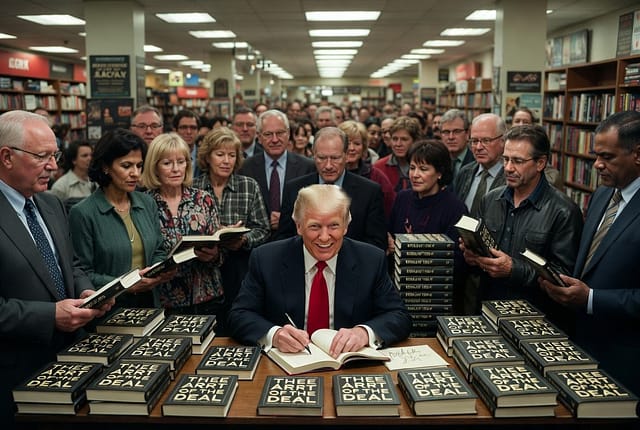
Given his propensity to exaggerate — and frankly, just to make stuff up, i.e., to lie — I decided to see what he means by the “Art of the Deal,” the book he wrote spelling out how he wins in negotiations. I have a premonition that he left out “lie a lot and just make shit up” as being part of the art.
With no particular desire to buy or read his book, I asked my AI friend Gemini to summarize the book and the meaning of “art of the deal.” Here is how he, she, it, they responded:
Donald Trump’s The Art of the Deal (1987), co-written with journalist Tony Schwartz, is part memoir and part business advice book. It reads like a high-energy playbook for transactional success, detailing the mindset and specific strategies Trump used to build his early real estate empire in New York City.
The overall argument of the book is that deals are an art form, and success doesn’t come from safe, incremental progress, but from a mix of bravado, aggressive risk-taking, total focus, and a gut-level understanding of human psychology. Trump frames business not as a dry science of spreadsheets, but as a competitive sport where perception creates reality.
Here are the main points and core strategies outlined in the book:
- The Core Philosophy: “Think Big”
Trump argues that most people think small because they are afraid of success or failure. His foundational premise is that if you are going to be thinking anyway, you might as well think big. Thinking big forces you to project an aura of grand scale and importance, which attracts the people, capital, and media attention required to pull off massive projects.
- Key Elements of the Deal
The heart of the book is a 11-step guide to how Trump approaches business. The most prominent elements include:
- Protect the Downside and the Upside Will Take Care of Itself: Contrary to his public image as a reckless gambler, Trump emphasizes being conservative in risk management. He advises always planning for the worst-case scenario so you can survive to fight another day.
- Maximize Your Options: Never commit to a single plan or a single deal. Trump advocates keeping multiple balls in the air so that if one negotiation falls through, you aren’t left with nothing. This also prevents you from looking desperate.
- Know Your Market: Trump expresses a deep distrust of traditional market research or consultants. Instead, he believes in “hand-to-hand” research—asking everyday people, contractors, and tenants their opinions to get a gut feel for what people actually want.
- Use Your Leverage: The worst thing you can do in a deal is come across as desperate. You must discover or create something the other side needs, or convince them that you have something of immense value, giving you the upper hand.
- Enhance Your Location: Trump challenges the classic real estate mantra “location, location, location.” He argues that you can take a mediocre location and make it great through superior promotion, prestige, and creating a unique destination (as he argued he did with Trump Tower).
- “Truthful Hyperbole” (The Media Strategy)
One of the most famous concepts introduced in the book is truthful hyperbole. Trump describes it as an innocent form of exaggeration—and a very effective method of promotion.
“People want to believe that something is the biggest and the greatest and the most spectacular. I call it truthful hyperbole.”
He argues that the media has an insatiable appetite for good stories and controversy. By giving them larger-than-life claims, you get free press, which is vastly more effective than paid advertising. Even negative press, he notes, is often better than no press at all because it keeps you at the center of attention.
- Deliver the Goods
While promotion and hyperbole get people through the door, Trump acknowledges that you cannot fool people forever. The final product has to back up the hype. If you don’t deliver a quality building, a good service, or a successful outcome, people will eventually catch on.
- Fight Back
Trump emphasizes a highly combative approach to resistance. He writes that when people treat you badly or try to screw you, you must hit back much harder. He frames confrontation not as a last resort, but as a necessary tool to earn respect and stop others from taking advantage of you.
Summary of the Narrative Arc
To prove these points, the bulk of the book walks through real-life case studies from the 1970s and 1980s. It details the complex chess matches behind building Trump Tower, transforming the dilapidated Commodore Hotel into the Grand Hyatt, his foray into Atlantic City casinos, and his highly publicized taking over of the Wollman Rink renovation in Central Park—which he finished ahead of schedule and under budget after the city of New York had failed for years.
Ultimately, The Art of the Deal argues that business is won by the person who is the most resilient, the most aggressive at self-promotion, and the quickest to seize an opening while everyone else is still analyzing the data.