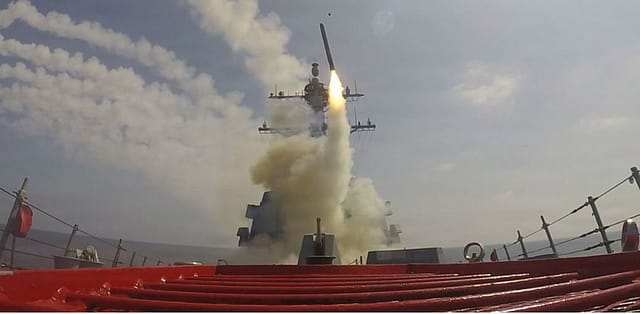
The Fake News, as Donald Trump likes to call media that don’t curry favor with him, are speculating that the Iran war has severely depleted U.S. weapons stockpiles, and that the U.S. has now abandoned its second offensive for that very reason. The White House insists the stoppage is due to the renewal of regional peace talks.
The bombing lull comes after a Friday meeting between Trump and advisers, including Secretary of Defense/War Pete Hegseth and Joint Chiefs General Dan Caine. According to the New York Times (probably number-one on Trump’s fake parade), Trump shelved plans for a major military escalation against Iran after being warned about dwindling inventory of Patriot interceptor missiles and other air defense munitions.
When asked by the Wall Street Journal if supplies were low, Trump in typical fashion said that things were better than ever and that “we have far more munitions than anyone in the world, and far more than we need.”
 According to the Center for Strategic and International Studies (CSIS), by the time of the April ceasefire in Iran, the U.S. had already expended at least half of its THAAD [Terminal High Altitude Area Defenses] ballistic missile interceptors, nearly half of its Patriot air defense interceptors, and around 30 percent of its Tomahawk land-attack missiles.
CSIS assesses that, even before the Iran hostilities began, the U.S. lacked the supplies needed for a war with China. Now, the nation is moving ever closer to what is called “going Winchester,” or running out of weaponry.
Replenishing stockpiles requires considerable expenditures of both time and money. For instance, a THAAD missile costs $15.5 million and takes 53 months to produce, a Patriot $3.9 million and 42 months.
Trump has requested $1.7 trillion for defense spending, including a munitions build-up to put the nation on “wartime footing,” but even if the budget is approved, it will take years for the stockpiles to reach such a level. Under then-President Biden, orders were so low that little was in the pipeline when the MAGA Master took office in 2025.
CSIS concludes:
“The diminished munitions stockpiles have created a near-term risk. A war against a capable peer competitor like China will consume munitions at greater rates than in this war. Prewar inventories were already insufficient; the levels today will constrain U.S. operations should a future conflict arise.”