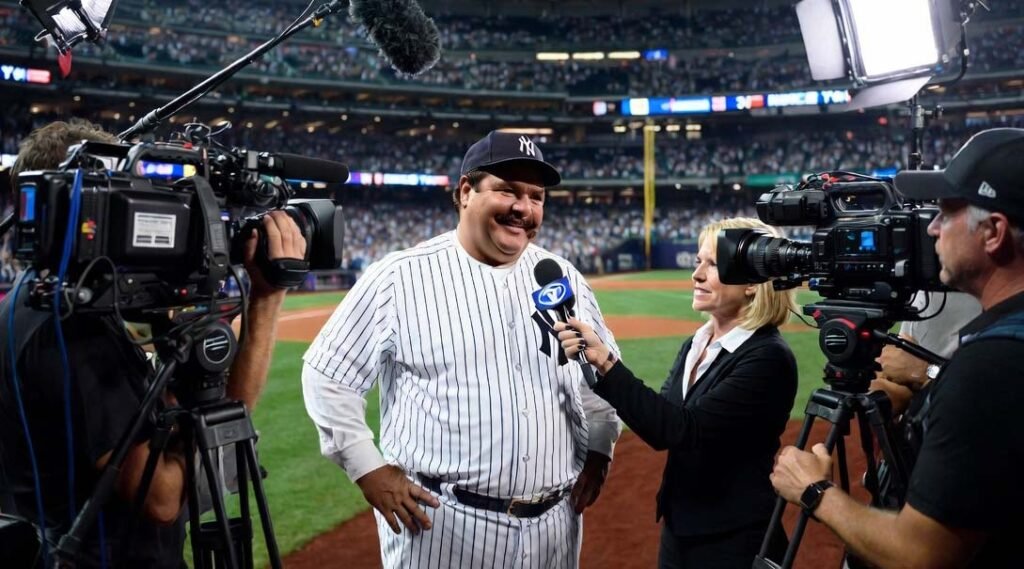
The only person I know who could answer my question — “How would Babe Ruth fare against today’s pitching?” — is my AI friend Gemini. What follows is his answer (illustration courtesy of my Grok subscription, close but not that great a resemblance to The Babe).
HINT: Either as a bench-warming bum or Aaron Judge-esque…. Read on:
This is one of the ultimate baseball debates. To answer it fairly, we have to look at it through two different lenses: dropping 1927 Babe Ruth straight out of a time machine onto a modern field, versus giving him access to modern sports science, nutrition, and training.
Here is how the physics and analytics break down the Bambino’s chances.
Scenario A: The Time Machine (0 to 15 Home Runs)
If you plucked Babe Ruth out of the 1920s and put him in a batter’s box tonight, he would look completely lost. That isn’t a knock on his legendary talent; it’s just a reflection of how much the physics of pitching have evolved.
- The Velocity Shock: In the 1920s, the average fastball sat around 85–88 mph. Rare elite pitchers like Walter Johnson could touch the mid-90s, but it was uncommon. Today, the average Major League fastball is over 94 mph, with dozens of relievers throwing 100+ mph nightly.
- The Spin Rate Revolution: Modern pitchers don’t just throw harder; they manipulate the baseball with elite spin physics. Ruth never had to face a 94 mph “rising” four-seam fastball with 2,500 RPM (revolutions per minute) of spin, followed by an 87 mph sweeper that breaks 18 inches horizontally.
- The Equipment Deficit: Ruth famously swung a massive hickory bat weighing between 40 and 54 ounces. Trying to bring a 42-ounce log around against a 98 mph high fastball is mechanically impossible. Modern hitters use ultra-balanced 31-to-33-ounce maple bats just to keep up with the reaction time required.
Without time to adjust to the sheer movement and speed, Ruth would likely strike out at an astronomical rate, managing only a handful of home runs off mistakes.
Scenario B: The Modernized Babe (35 to 45+ Home Runs)
Now, let’s change the parameters. What if Babe Ruth were born in 1998, grew up with travel baseball, utilized video analysis, and trained at modern data-driven facilities like D3 or Driveline?
If you give him modern advantages, he is still an elite, MVP-caliber slugger. Here is why his traits translate perfectly to the modern game:
- He Was the Original “Launch Angle” Hitter
Before Statcast tracked how high a ball was launched, Ruth was actively trying to hit it in the air. In an era when players were taught to choke up and slap grounders, Ruth swung from his heels with a natural, upward-looping arc. He would absolutely love the modern analytical emphasis on barrel percentage and launch angle optimization.
- Elite Hand-Eye Coordination and Bat Speed
Historical accounts and early sports science testing (like the famous 1921 Columbia University study) showed that Ruth possessed freakish neurological reaction times and visual acuity. His hand-eye coordination was in the top 1% of the population. If you give that genetic foundation modern sports nutrition, weight training, and pitch-tracking technology, his bat speed would easily match today’s elite standard.
- Better Hitting Conditions
While the pitching is tougher, other elements of the modern game would actually benefit him:
- Lighter Bats: Upgrading to modern maple bats would instantly skyrocket his bat speed.
- Smaller Stadiums: The outfield fences in the 1920s were massive. At the original Yankee Stadium, left-center field was 460 feet, and center field was 490 feet. Ruth hit countless 430-foot flyouts that would be rows deep in any modern ballpark.
- No “Dead” Balls: In Ruth’s era, a single baseball was often kept in play until it was practically black with dirt, scuffed, and soft. Today, balls are replaced at the slightest scuff, offering maximum coefficient of restitution (bounciness).
The Verdict: A modernized Babe Ruth would look a lot like a left-handed Aaron Judge or Kyle Schwarber—a high-walk, high-strikeout power threat who routinely blasts 40+ home runs a year and challenges for the league lead in On-Base Plus Slugging (OPS).