President Trump met the press today as details were emerging about the memorandum of understanding (MOU) the U.S. and Iran have agreed to. Pressed about why he is accepting the deal, Trump confessed to worrying about becoming Herbert Hoover II.
Hoover, of course, was president when the Great Depression began with the Stock Market Crash of 1929, and he subsequently received a substantial part of the blame for the ensuing economic turmoil. His successor, FDR, or Franklin Delano Roosevelt, did a good job of pinning everything on Hoover, and on Republicans in general, making Democrats the majority party until Ronald Reagan came along 50 years later.
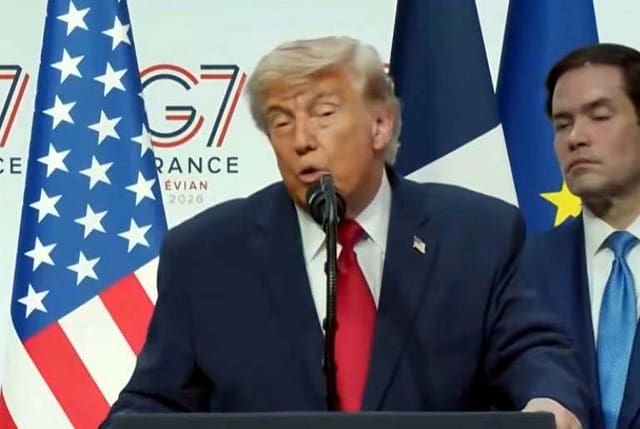
Trump told reporters at the Hôtel Royal in Évian-Les-Bains, France, site of the G7 Summit, that, if he continued the war/standoff with Iran, markets “would go down at levels that nobody ever saw before, maybe except for 1929. The one President I did not want to be was the late, great Herbert Hoover.”
Hoover, of course, did little to solve the depression, but that was because it was largely initiated by the Bank of England’s raising interest rates, with the U.S. Federal Reserve following suit. The U.S. economy was highly leveraged — in massive debt, in other words, even on Wall Street — and higher rates meant financing became virtually unattainable. Banks were overrun by depositors cashing out and began crashing worldwide, beginning with the Creditanstalt (Credit-Anstalt) in Vienna, Austria.
Hoover did share one thing in common with Trump. He raised tariffs, helping expand and prolong the agony of the Great Depression. In that regard, Trump should definitely worry about becoming Herbert Hoover II. in that regard
Trump has a bigger historical predecessor to fear becoming, however, and that person is British Prime Minister Neville Chamberlain. The British PM met with Adolph Hitler at Munich in 1938 and caved to all of Der Führer’s demands, giving him the Sudetenland in exchange for “peace for our time,” which ended a year later with World War II.
The MOU released today — and signed by Trump at the Palace of Versailles in France — pretty much gives in to all of Iran’s demands. Not only that, but it immediately enriches the country by lifting sanctions and allowing Iranian oil tankers to hit the seas immediately. It also pledges $300 billion in aid and allows missile and drone development — rearmament, basically.
It has one clause about Iran’s not developing or acquiring a nuclear weapon, but that clause is subject to further negotiations and is not necessarily binding immediately.
So, President Chamberlain, do we have “peace for our time”?