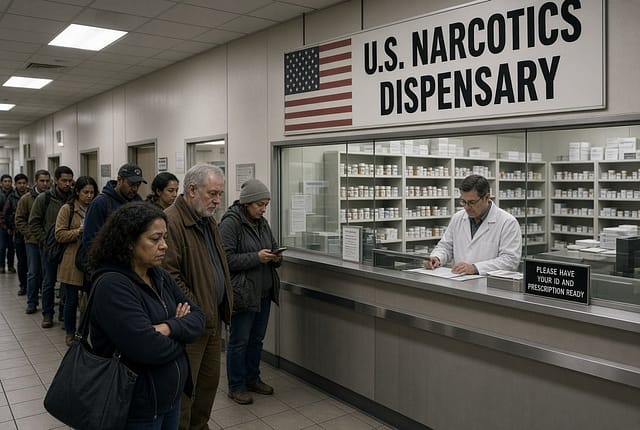
The U.S. is now using drones to take out cartel sites and drug supplies in Latin America. Earlier this year, we abducted a leader of another country to try on drug charges. On and on we go pursuing our never-ending “War on Drugs.”
The CATO Institute estimates that the direct cost to enforce drug prohibition strictly is roughly $47 billion annually. The Prison Policy Initiative points out that 1 in 5 incarcerated people in the U.S. are locked up for a drug offense. Managing mass incarceration as a byproduct of drug enforcement costs federal and state governments upward of $182 billion each year.
Since its formal inception under President Richard Nixon in 1971, the total cost of the American “War on Drugs” has surpassed an estimated $1 trillion. Portugal, 25 years ago, facing some of the highest drug affliction and abuse rates in Europe, decided on a new approach: not legalization, but open access and decriminalization with back-up health and recovery facilities. Here is that nation’s story (it ain’t necessarily cheap, but it works):
In 2001, Portugal adopted a groundbreaking public health approach by enacting Law 30/2000, which decriminalized the acquisition, possession, and personal consumption of all illicit drugs (defined as up to a 10-day supply).
Rather than legalizing drugs (drug trafficking and sales remain serious criminal offenses), Portugal shifted drug abuse from a criminal justice issue to a public health model. Anyone caught with drugs is referred to a regional panel known as a Commission for the Dissuasion of Drug Addiction (CDT)—composed of legal, social work, and medical professionals—to evaluate their needs and offer voluntary treatment, harm reduction, or minor administrative sanctions.
Core Successes
Drastic Drop in Health Crises and Overdoses: In the 1990s, Portugal faced an epidemic of heroin addiction and had the highest rate of drug-related HIV infections in the EU. Following decriminalization and investments in needle exchanges, methadone clinics, and harm reduction, new drug-related HIV infections plummeted by over 90%. Overdose death rates dropped significantly, placing Portugal well below the European average.
Increased Voluntary Treatment: Shifting from imprisonment to health interventions removed the stigma of seeking help. Voluntary uptake in addiction treatment programs grew dramatically.
Reduced Incarceration & Criminal Justice Costs: Overcrowded prisons saw a sharp decline in inmates held for minor drug offenses. This freed up police, judicial, and corrections resources to focus on high-level organized crime and drug trafficking rather than individual users.
Overall Societal Cost Savings: Studies indicated that the per capita social cost of drug misuse (accounting for healthcare expenses, legal costs, and lost productivity) fell by roughly 18% over the decade following the reform.
Failures and Growing Challenges
Vulnerability to Budget Cuts: The Portuguese model relies heavily on active, well-funded public health and social support systems. Following the 2008 financial crisis and subsequent austerity measures, government funding for drug treatment, outreach teams, and rehabilitation was severely reduced.
Recent Rebound in Drug Use & Public Nuisance: Disinvestment led to a visible resurgence of open-air drug markets, public drug use, and urban debris in major cities like Lisbon and Porto. Overdose rates and drug-related crime indicators have slowly crept upward from their historical lows.
Law Enforcement Friction: Police officers have expressed frustration over a perceived lack of enforcement tools, reporting that individuals referred to CDTs frequently ignore appearances or decline non-mandatory treatment.
Inability to Stop Supply: Decriminalizing demand does not eliminate illicit supply chains. Portugal remains a major maritime entry point for international drug syndicates trafficking cocaine and synthetic substances into Europe, maintaining high drug availability on the streets.
Key Takeaway
Portugal’s experience demonstrates that decriminalization can yield massive public health gains—but only when backed by robust funding for treatment, social reintegration, and harm reduction. Decriminalization alone is not a static cure; without sustained funding and dynamic enforcement strategies, public health victories can erode over time.
Share the Truth on Your Media: