Claim 1: Café Idéal in Warwick (1957)
The most famous origin story credits Fernand Lachance, owner of Café Idéal (later renamed Le Lutin qui rit) in Warwick, Quebec.
The Story: In 1957, a regular customer named Eddy Lainesse asked Lachance to put a handful of cheese curds into a paper bag along with his order of French fries so he could eat them together on the go.
The Name: Lachance famously replied, “Ça va te faire une maudite poutine!” (“That will make a damned mess!”).
The Gravy: By 1963, customers complained that the fries were cooling off too fast when served together on a plate, so Lachance added hot gravy to keep the mixture warm and bind it together.
Claim 2: Le Roy Jucep in Drummondville (1964)
Jean-Paul Roy, owner of the drive-in diner Le Roy Jucep in Drummondville, claims to have invented the complete three-ingredient dish as we know it today.
The Story: Since 1958, Roy had been serving patate-sauce (fries with a proprietary savory gravy). When he noticed patrons buying bags of cheese curds from his counter and dumping them into their gravy-soaked fries, he officially added the combination to his menu in 1964 as fromage-patate-sauce.
Official Recognition: Roy eventually registered a trademark for the dish and obtained official recognition from the Canadian Intellectual Property Office as the registered inventor of poutine.
Claim 3: La Petite Vache in Princeville (1966)
Another notable contender is La Petite Vache in Princeville. Located right next to the Princesse cheese factory, the restaurant began selling curds at the cash register. Customers began mixing the curds with their fries and gravy at their tables, leading the restaurant to list the combination as the “Mixte.”
Etymology: Where Did the Name “Poutine” Come From?
The exact origin of the word poutine is debated, though linguists generally agree on a few theories:
Québécois Slang for “Mess”: In regional French slang, poutine was often used to describe an odd, haphazard mixture or a mess.
Derivation of “Pudding”: It is widely believed to be a Francized version of the English word pudding (or pouding), used historically to refer to any thick or mixed culinary concoction.
The Cook’s Nickname: At Le Roy Jucep, servers reportedly referred to odd food combinations using the slang pouding, noting that a cook nicknamed Ti-Pout made the dishes—blending the two into poutine.
Spread and Cultural Evolution
Urban Expansion (1960s–1980s): Poutine migrated from small rural towns to major cities. It arrived in Quebec City via the Chez Ashton food truck in 1969 and spread through Montreal in the early 1980s.
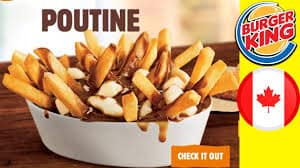
Mainstream Acceptance (1980s–1990s): Once looked down upon by some as a greasy, working-class street food, major fast-food chains (Burger King in 1987, McDonald’s in 1990) began serving it across Quebec and Canada, solidifying its place as a national staple.
Haute Cuisine & Global Variations (2000s–Present): High-end chefs began elevating the dish with gourmet ingredients like duck fat, braised short ribs, and foie gras (pioneered by Chef Martin Picard at Montreal’s Au Pied de Cochon).
Summary Checklist of Classic Poutine Ingredients
To be considered an authentic Québécois poutine, the dish requires three non-negotiable elements:
| Component | Standard Requirement |
| Fries | Medium-cut, double-fried (crispy on the outside, soft inside) |
| Cheese | Fresh, unpasteurized curds (must “squeak” when chewed; never melted grated cheese) |
| Gravy | Hot, light brown poultry or beef-based sauce (sauce poutine) to soften the curds without completely melting them |