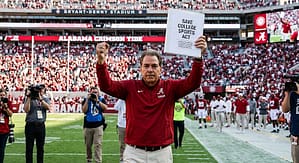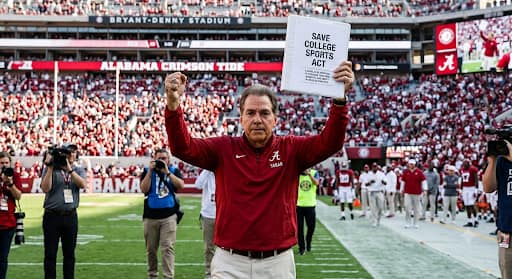
When the money got going, Nick Saban got going — when the money got going to college athletes, that is. After the Supreme Court opened the floodgates for college athletes to be paid cash rather than just scholarships, University of Alabama football coach Nick Saban — accustomed to yearly national championships — saw the dollar signs on the chalkboard and decided to retire.
There was no way a school in Tuscaloosa, Alabama, could compete donor-wise with its bigger northern rivals. Saban quickly bowed out, saying to this day that it had nothing to do with the increased competition. Even on ESPN this morning, he waffled about his reason for retiring when Stephen A. asked about it.
Since his “retirement,” Saban has been busy trying to fix the money mess NCAA schools find themselves in, while he himself is enriching himself with lucrative TV deals. He even lobbied Congress for a fix, and in response, the Senate yesterday passed the Protect College Sports Act. Now, it goes to the House for approval.
Here are the details of that bill:
The legislation officially named the Protect College Sports Act (commonly referred to alongside “Save College Sports” efforts) passed the Senate in a major bipartisan 77–22 vote.
Led by Senators Ted Cruz and Maria Cantwell, the bill seeks to address the landscape of college athletics created by unrestricted Name, Image, and Likeness (NIL) collectives, constant roster turnover, and massive conference realignment.
Key Provisions of the Legislation
National Standard for NIL & Federal Preemption
Preempts the conflicting “patchwork” of state NIL laws, creating a uniform, federal framework.
Grants student-athletes a codified federal right to sign NIL deals and retain representation.
Caps sports agent fees at 5% and establishes a mandatory federal agent registry to curtail predatory practices.
Player Revenue Sharing & Retention Funds
Codifies player direct-compensation mechanisms (arising from recent court settlements), allowing schools to share up to $21.5 million in direct revenue with athletes.
Introduces an additional $27.5 million retention fund allowance for top-tier revenue-generating programs, essentially raising the maximum potential payroll cap toward $49 million annually.
Allows conferences and universities to pool TV/media rights to help generate and backstop these payments.
Transfer Portal Restrictions & Tampering Enforcement
Re-instates a “one free transfer” rule over a player’s 5-year eligibility window; subsequent undergraduate transfers would require sitting out a year unless meeting specific hardship exemptions.
Re-empowers the NCAA and conferences to enforce designated transfer windows and penalize mid-season roster tampering or unauthorized recruiting inducements.
Conference Realignment & Super League Caps
Caps official conference memberships at 20 schools to halt further consolidation into mega-conferences.
Imposes a penalty on schools jumping between power conferences, requiring any transferring program to compete as an independent for three academic years.
Student-Athlete Health, Safety & Academic Protections
Mandates Division I programs to cover out-of-pocket medical expenses for athletic injuries for current athletes and up to 5 years post-eligibility.
Guarantees athletic scholarships for up to 10 years so athletes can finish their degrees, preventing schools from revoking aid due to injury or performance.
Establishes minimum sport count rules to protect Olympic and women’s sports from being cut as schools pivot revenue toward football payrolls.
Targeted Antitrust Exemption
Grants the NCAA and conferences limited federal antitrust immunity specifically to enforce roster limits, revenue caps, transfer windows, and eligibility rules without facing constant federal class-action lawsuits.
Implications for College Football
Stabilization of Roster Turnover: Restricting undergraduate transfers and re-establishing tampering penalties ends the “free-agent every off-season” dynamic. Head coaches will have better roster predictability and multi-year depth management.
Widening Separation Between Powerhouse Programs: The $27.5 million retention fund allowance lets powerhouses (primarily in the Big Ten and SEC) spend upwards of $45M–$50M annually on rosters, solidifying their competitive advantage over mid-tier programs while bringing direct payroll spending above board.
Freezing Conference Realignment: The 20-school cap and 3-year independent penalty put an immediate brake on further expansion (such as potential further moves by ACC schools or super-league breakaways).
Long-Term Financial Obligations for Athletic Departments: Extended medical coverage and guaranteed 10-year academic scholarships raise non-payroll operating costs across all DI football-sponsoring institutions.
(Note: The legislation now moves to the U.S. House of Representatives, where it faces scrutiny over conference alignment penalties and athlete employee status before potential enactment into law.)