The United Arab Emirates (UAE) reports that one of its ships was attacked by Iran in the Strait of Hormuz on Saturday, the third such event in the past week. The missile assault comes after Iran and Oman had wrapped up talks to open the Strait of Hormuz — depending on concessions by the U.S.
President Trump hasn’t responded to the Iranian demands yet, but they clearly represent concessions he has previously ruled unacceptable. Their demands include an end to the U.S. blockade of Iranian shipping, a release of frozen Iranian assets, and an end to sanctions. But that’s just the starting point: The U.S. must also remove its forces from the region, pay war reparations, end all attacks on Iran’s allies, and agree to a permanent denial of U.S. Naval vessels entering the Strait.
Iran admits that the deal it struck with Oman over the Strait is still subject to ultimate approval, presumably by the Supreme Leader, but more likely by the Islamic Revolutionary Guard Corps (IRGC). At the start of the Iran-U.S. conflict, IRGC forces were given the green light to take offensive measures against the U.S. and its allies. Thus, even as a pact is finalized to open passage through the Strait, the IRGC feels free to launch missiles and drones on ships transiting through.
According to the New York Times, “Hossein Mohebbi, a spokesman for Iran’s Islamic Revolutionary Guards Corps, said that reopening the strait was ‘not contingent on the Iran-Oman negotiations’.”
Trump was set to launch another attack on Iran a week ago when Gulf nations begged him to back off over fear of what Iran would do to their countries in response. The president thus faces a double whammy: He probably can’t get Iran to agree to his terms for nuclear disarmament without further military action, and he can’t really launch any strikes because Gulf allies don’t want them and because midterms are just around the corner. He needs a deal ASAP, and Iran knows it.
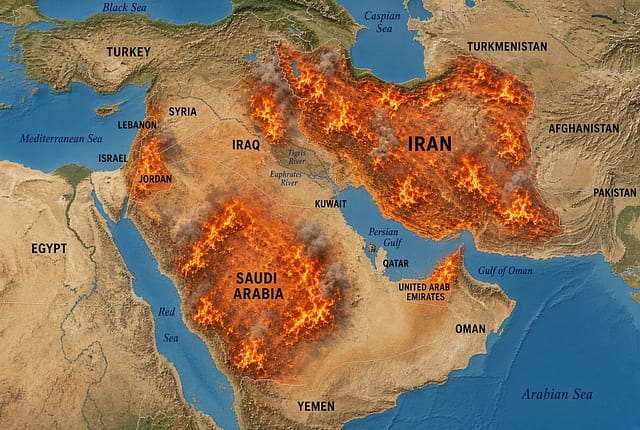
Complicating all this (and I predict further attacks coming soon) is a mutual-defense pact signed by Saudi Arabia, Turkey, and Pakistan. The NATO-like agreement means, in essence, that if Iran attacks Saudi Arabia, which it has done throughout the war, then Turkey and Pakistan would have to come to the Saudis’ aid.
That’s another challenge for Trump and company. Renewing a military offensive against Iran and the IRGC could result in a much wider conflict that would be infinitely harder to resolve.