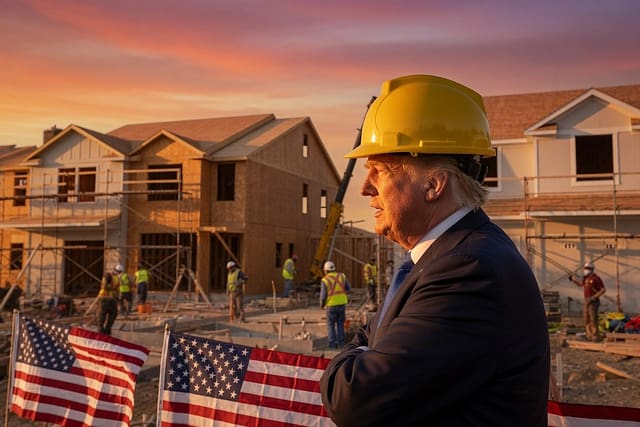
UPDATE: President Trump has tabled signing the ROAD to Housing Act until Senators pass the SAVE American voter ID act. Evidently, a meeting with Senators over the issue grew contentious and even belligerent.
Both Democrats and Republicans, in both the House and the Senate, have finally found common ground — the need to increase the nation’s housing stock, in hopes of thereby reducing the cost of homes in general.
The House of Representatives voted 358-32 and the Senate 85-5 to pass the 21st Century ROAD to Housing Act. President Trump will gladly sign it, as he had personal input into writing the legislation. The bill includes no new funding, but it seeks to streamline some federal regulations, including those for certain environmental reviews and for building manufactured homes. The measure also ties available federal funding to cities’ new housing production.
In addition, the ROAD to Housing Act provides grants and incentives to convert vacant, commercial, or underutilized buildings into affordable housing. At Trump’s urging, the law also limits large institutional investors and private equity firms from purchasing single-family homes.
The measure, however, is being met with some skepticism by homebuilders for a couple of reasons. One reason is that local regulations are generally the biggest hurdle to the construction of new housing. Another reason is that interest rates are still fairly high, and indications from the Federal Reserve are that federal fund rates may go higher, increasing mortgage and construction financing rates at the same time.
Inflation in the cost of building materials is also a huge factor, and this measure does nothing to address that issue.
The Bipartisan Policy Center offers a comprehensive look at the legislation.