When Benjamin Franklin emerged from the Constitutional Convention in 1787, a woman reportedly asked him what kind of government the delegates had created. “A republic,” he replied, “if you can keep it.”
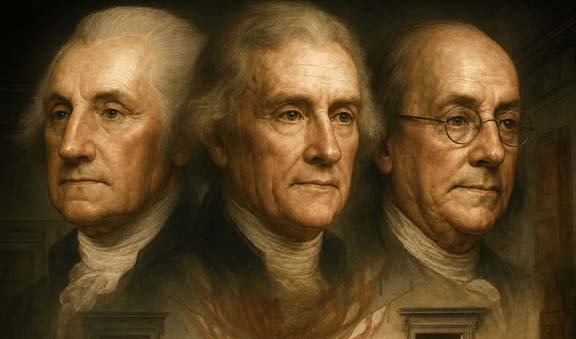
Two hundred and thirty-nine years later, if Franklin, Washington, and Jefferson were suddenly transported to 2026 America for our 250th anniversary, that conditional “if” would hang heavy in the air. Each man would arrive with different eyes, different fears, and radically different prescriptions for what has become of their experiment.
Franklin: The Delighted Diagnostician
Of the three, Benjamin Franklin would adjust fastest. This shouldn’t surprise us. The man who arrived in Philadelphia as a teenage runaway and left as the most famous American in the world was nothing if not adaptable. A printer who became a scientist, a scientist who became a diplomat, a diplomat who became a founding father—Franklin’s genius was his refusal to be confined by any single identity.
Drop him into 2026, and within hours he’d have figured out how to unlock an iPhone.
His first stop would inevitably involve electricity. The force he famously flew a kite to understand now powers everything—every light, every screen, every server farm humming with the sum of human knowledge. Franklin would be utterly vindicated. “I knew that spark had potential,” he might say, scrolling through Wikipedia at 3 AM, “but you’re telling me you carry the entire library of Alexandria in your pocket, and you use it primarily to argue with strangers and watch videos of dancing teenagers?” Because that’s where Franklin’s delight would curdle into concern: not the technology itself, but how we’ve deployed it. Franklin was America’s first media mogul. He understood the printing press not just as a machine but as a weapon of mass persuasion. Under pseudonyms like Silence Dogood and Poor Richard, he shaped colonial opinion, sold newspapers, and made himself wealthy in the process. He would instantly grasp the mechanics of TikTok, Instagram, and X (formerly Twitter)—platforms that are simply printing presses operating at the speed of light, unbound by geography or editorial oversight. “Anonymity,” he might observe, watching a conspiracy theory go viral in real-time, “is a powerful shield for liberty. But when the printing press moves faster than human reason, truth is easily trampled by loud fools with large followings.” The algorithmic feed would fascinate him. The engagement metrics would make perfect sense to a man who once published fake letters to his own newspaper to boost sales. But the absence of gatekeepers—the way misinformation spreads unchecked, the way foreign actors manipulate American discourse, the way rage generates more clicks than reason—would genuinely alarm him. Franklin believed in the marketplace of ideas, but he assumed that marketplace had some quality control. When he turned his attention to politics, the alarm would deepen into dread. Franklin despised rigid ideology. At the Constitutional Convention, he was the elder statesman urging compromise, reminding delegates that none of them would get everything they wanted, that the only path forward was mutual sacrifice. He believed the republic would survive only if citizens prioritized the common good over factional advantage. Modern Washington would look like his nightmare made flesh. A Congress with single-digit approval ratings, unable to pass basic budgets without lurching toward government shutdowns. A Supreme Court whose decisions are predictable based solely on which president appointed which justice. A political culture where compromise is treated as betrayal and the opposing party as an existential threat rather than a loyal opposition. “We gave you a framework for compromise,” Franklin might say, watching a Congressional hearing devolve into partisan theater, “not a stage for permanent warfare. A house built on stubbornness cannot weather the storm.” Yet Franklin wouldn’t despair entirely. He’d see the massive public libraries, the research universities, the hospitals—institutions he helped pioneer, now operating at scales he couldn’t have imagined. He’d recognize that American innovation still leads the world, that the scientific method he championed has produced genuine miracles. What would trouble him is the fraying social fabric. Franklin’s Poor Richard’s Almanack preached industry, frugality, and civic obligation. He organized volunteer fire departments, subscription libraries, and mutual aid societies because he believed a community’s strength lay in its willingness to help itself. The modern culture of hyper-individualism and conspicuous consumption would baffle him. “Industry produces wealth,” he might conclude, “but virtue produces happiness. You have accumulated immense wealth as a nation, yet you seem to have forgotten how to be neighbors.” Still, Franklin wouldn’t retreat to the past. Within weeks, he’d probably have a viral social media presence, a tech startup exploring AI applications, and a weekly column eviscerating both political parties—all while quietly filing patents for green energy solutions. Franklin’s instinct was always to build, to tinker, to improve. He’d see 2026 America as a magnificent machine badly in need of repair, and he’d grab his tools. George Washington and Thomas Jefferson would react very differently—not just from Franklin, but from each other. Washington would arrive like a disappointed father surveying a house party that got catastrophically out of hand. Everything he warned against has come to pass, and worse, everyone ignored the warning. His 1796 Farewell Address reads like prophecy now. He cautioned against “the baneful effects of the spirit of party,” predicting it would lead to “frightful despotism.” He warned against permanent foreign alliances and excessive national debt. He urged Americans to preserve the Union above all else, to resist regional and factional divisions, to cultivate civic virtue and public credit. Walking through 2026, Washington would feel vindicated in the worst possible way. The political parties he explicitly warned against now dominate everything. The $36 trillion national debt would horrify a man who viewed fiscal responsibility as a moral imperative. The permanent military entanglements across the globe—the very foreign alliances he cautioned against—would seem like a betrayal of his core principles. The coarseness of modern political discourse, the collapse of decorum, the treatment of the presidency as a prize to be won rather than a burden to be borne—all of it would strike him as a failure of character. “I explicitly warned you,” Washington might say, his voice cold with disappointment, “against factions and foreign entanglements. Yet you have built your entire political system upon them. Where is the civic virtue that justifies this liberty?” Washington would find Franklin’s fascination with modern media irresponsible. To a military commander who valued discipline and order, the constant chaos of the news cycle would look like a national security threat. He’d see the January 6th Capitol riot not as a political aberration but as the logical endpoint of unchecked factionalism. He’d view the inability to conduct peaceful transitions of power as the death rattle of the republic. Unlike Franklin, Washington wouldn’t try to fix the system from within. He’d call for a return to first principles: duty, honor, sacrifice, and the subordination of personal ambition to national interest. He’d demand that leaders lead by example, that they demonstrate the character worthy of free citizens. And he’d be profoundly pessimistic about whether modern America was capable of such a restoration. Thomas Jefferson would arrive with an entirely different diagnosis and a far more radical prescription. Jefferson hated centralized power with a passion that bordered on obsession. He envisioned America as a nation of independent farmers, each man sovereign on his own land, with a minimal federal government that existed primarily to deliver the mail and stay out of the way. He famously argued that “the tree of liberty must be refreshed from time to time with the blood of patriots and tyrants,” and suggested the Constitution should be rewritten every nineteen years so each generation could govern itself. The modern federal government would look to Jefferson like the very tyranny he spent his life fighting. The Pentagon, with its $850 billion annual budget and military bases in over 80 countries. The regulatory agencies—EPA, FDA, SEC, FCC—with their thousands of employees and millions of pages of rules. The Federal Reserve, controlling the money supply. The surveillance apparatus revealed by Edward Snowden. The corporate consolidation that has created monopolies in industry after industry. The fact that most Americans now live in sprawling suburbs and cities rather than on independent farms. All of it would represent, to Jefferson, a catastrophic failure of the American experiment. “You live under the laws of dead men from two centuries ago,” he might declare, his voice rising with revolutionary fervor. “This government has become the very leviathan we bled to escape. It is long past time for a peaceful rebellion to decentralize this power and return it to the people and the states.” Yet here’s where Jefferson would surprise us: unlike Washington, he’d be thrilled by certain aspects of modernity. The internet would fascinate him. As a man who spent a fortune on books and obsessively collected knowledge, the democratization of information would seem like a dream realized. He’d see in modern technology the potential to bypass representative government entirely—to create direct democracy on a scale previously impossible. Town halls conducted via video conference. Referendums decided by secure digital voting. Citizens drafting legislation collaboratively online, without the filter of professional politicians. Where Franklin would try to fix the system and Washington would demand a return to virtue, Jefferson would want to tear down the entire structure and rebuild it from scratch using 21st-century tools. “The earth belongs to the living,” he’d remind us, quoting himself. “No generation should be bound by the decisions of those who came before. You have the technology now to govern yourselves directly. Why do you still bow to this bloated federal apparatus?” Imagine all three in a room together, watching cable news coverage of a Congressional budget standoff while doomscrolling their phones. Franklin would be sketching out a new civic organization, something that uses social media algorithms to promote local community engagement instead of outrage. He’d be thinking about incentive structures, about how to make virtue viral, about whether blockchain technology could create more transparent governance. “The tools are remarkable,” he’d mutter. “The question is whether we’re wise enough to use them well.” Washington would have turned off the television in disgust. He’d be reading the national debt clock with mounting horror, calculating how many years of tax revenue it would take to pay down even a fraction of it. He’d be drafting a new farewell address, knowing no one would listen, but compelled by duty to try anyway. “Character,” he’d say quietly. “Without character, no system of government can survive. And I see precious little character in your leaders.” Jefferson would be on his laptop, writing a new declaration of independence. He’d be researching which states have the strongest movements toward decentralization, which technologies could enable direct democracy, which legal frameworks might allow for peaceful dissolution of federal power. “The experiment has failed,” he’d announce. “Not the idea of America, but this particular implementation. It’s time to reboot.” And they’d argue. Franklin would accuse Jefferson of dangerous radicalism, of forgetting that most people don’t want to spend their evenings voting on municipal water policy. Washington would accuse Franklin of treating serious matters like a game, of being too clever by half. Jefferson would accuse Washington of nostalgia for a past that never existed, of wanting to restore a virtue that was always more myth than reality. But here’s what they’d agree on: the republic is in danger. Not from foreign enemies or domestic terrorists, but from something more insidious—the slow erosion of the civic culture that makes self-government possible. The replacement of citizenship with consumerism. The substitution of tribal loyalty for reasoned debate. The prioritization of short-term advantage over long-term survival. Franklin would want to innovate our way out. Washington would want to restore our way back. Jefferson would want to revolutionize our way forward. And standing in 2026, on the eve of America’s 250th birthday, we’d have to decide which founder’s vision—if any—offers the path to 2076. “A republic,” Franklin said, “if you can keep it.” The question has never been more urgent: Can we?Washington and Jefferson: The Stoic and the Revolutionary
Three Founders, Three Futures