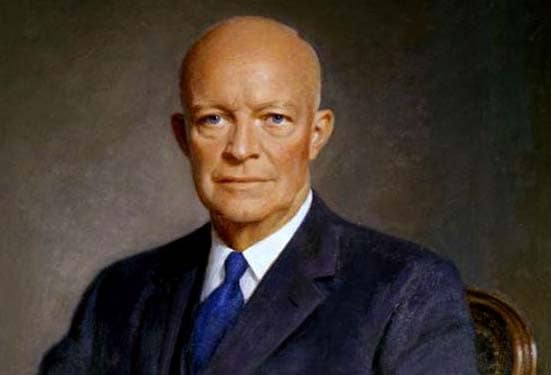
When Dwight D. Eisenhower entered the White House in 1953, the United States was deeply polarized. The country was locked in the Cold War abroad, and at home, fierce debates raged between New Deal Democrats who wanted to expand government programs and conservative Republicans who wanted to completely dismantle them.
Eisenhower’s solution was The Middle Way (sometimes called “Modern Republicanism”). It was a political philosophy that rejected extremes on both sides. He described it as a path where “the government does not avoid its responsibilities to the human individual,” but also “does not assume that the federal government is the only instrument for solving all human problems.”
In short: be conservative when it comes to money and the economy, but liberal when it comes to human beings.
The Core Pillars of the Middle Way
To understand how Eisenhower balanced these competing ideas, it helps to look at how he handled the biggest issues of his presidency:
- Reining in Government Spending
Eisenhower was a fiscal conservative. He believed that a runaway national debt and high inflation were just as dangerous to national security as a foreign military threat.
- Balancing the Budget: He worked hard to balance the federal budget, successfully achieving surpluses in three of his eight years in office.
- Defense Cuts: Despite being a legendary five-star general, he actually cut the defense budget. He warned against the growing power of the “military-industrial complex” and relied on a “New Look” foreign policy that favored a nuclear deterrent over maintaining a massive, expensive conventional army.
- Protecting the Social Safety Net
While conservative Republicans wanted to roll back Franklin D. Roosevelt’s New Deal programs, Eisenhower flatly refused. He famously wrote to his brother Edgar that any political party that tried to abolish Social Security and unemployment insurance would “not be heard of again in our political history.”
- Expanding Benefits: Instead of destroying the New Deal, he expanded it. He extended Social Security coverage to an additional 10 million Americans and increased the minimum wage.
- Department of Health, Education, and Welfare (HEW): In 1953, he created this new cabinet-level department to better organize and oversee federal welfare programs, cementing the government’s role in social well-being.
- Massive Infrastructure Projects
Eisenhower believed the federal government should fund massive projects, but only if they were essential for national defense, economic growth, and unity—not just to create government jobs.
- The Interstate Highway System: Launched by the Federal-Aid Highway Act of 1956, this was the largest public works project in American history at the time. Inspired by the German Autobahn he saw in WWII, Eisenhower championed the 41,000-mile network because it would allow the military to move troops quickly during an invasion and turbocharge interstate commerce.
The Philosophy in Action
Eisenhower viewed the Middle Way as a dynamic balancing act. He often used a metaphor about driving a car down a road: if you lean too far to the right, you end up in the ditch of reaction and stagnation; if you lean too far to the left, you end up in the ditch of centralized government control and inflation.
By steering straight down the middle, Eisenhower managed to maintain an incredibly high approval rating (averaging over 60%) and presided over a period of historic economic growth and relative peace. It proved that a middle-ground approach could not only win elections but successfully govern a divided nation.