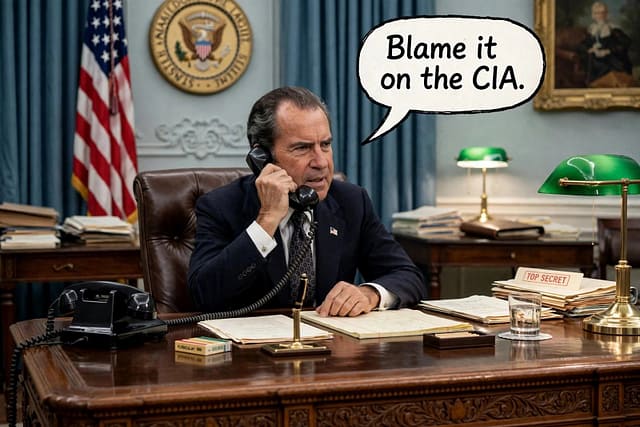
Central to this hypothesis is the conduct of James McCord, a veteran CIA security officer serving as the security director for the Committee to Re-elect the President (CRP). During the operation, McCord placed adhesive tape horizontally across the latches of several doors in the Watergate building. The tape was discovered and removed by a security guard on duty. Rather than aborting the mission after the security breach was detected, McCord replaced the tape, virtually guaranteeing that the guard would discover the intrusion and summon the police.
Hougan argued that such elementary mistakes were uncharacteristic of a seasoned counterintelligence professional. In his analysis, the true objective of the surveillance had little to do with obtaining conventional political intelligence on the Democratic Party. Instead, Hougan suggested the operation was linked to an unauthorized intelligence activity involving a call-girl ring or the protection of agency secrets. By purposefully sabotaging the entry, Hougan posited, McCord ensured the operation would be exposed, shifting culpability directly onto the White House while insulating the CIA from deeper scrutiny.
The National Security Apparatus and the ‘Silent Coup’
A broader institutional thesis was presented in 1991 by Len Colodny and Robert Gettlin in Silent Coup: The Removal of a President. Colodny and Gettlin expanded the scope of revisionist critique by asserting that Watergate was an internal operation coordinated by military and national security figures seeking to replace Nixon with Vice President Gerald Ford.
According to Colodny and Gettlin, senior defense and intelligence figures, including elements within the Joint Chiefs of Staff, viewed the foreign policy pursued by Nixon and National Security Advisor Henry Kissinger with deep alarm. The administration’s policies of détente with the Soviet Union, the opening of diplomatic relations with the People’s Republic of China, and the phased withdrawal of American troops from Vietnam were seen by critics in the defense establishment as dangerous concessions.
The authors argued that White House Counsel John Dean played a central role in orchestrating the initial break-in for private motivations—specifically, an effort to locate and retrieve photographs connected to his fiancée. Concurrently, national security officials, including figures such as Alexander Haig, were alleged to have influenced the flow of information, leaks, and press coverage to ensure the resulting scandal targeted the Oval Office directly and culminated in Nixon’s resignation.
Blackmail and the ‘Bay of Pigs’ Exchange
A third major thread of revisionist speculation emerged from within the Nixon administration itself, articulated in former Chief of Staff H. R. Haldeman’s 1978 memoir, The Ends of Power, and subsequently echoed by Nixon. This argument centers on the administration’s attempts to enlist the CIA in containing the expanding Federal Bureau of Investigation probe.
In the recorded Oval Office conversation from June 23, 1972—later termed the “Smoking Gun” tape—Nixon instructed Haldeman to approach CIA Director Richard Helms and suggest that allowing the FBI to pursue its investigation would risk exposing sensitive covert actions, telling Haldeman to warn that the probe would “open up the whole Bay of Pigs thing.”
Haldeman later claimed that “Bay of Pigs” served as White House code for the CIA’s most sensitive covert activities, including foreign assassination plots against leaders such as Fidel Castro or covert actions related to the assassination of John F. Kennedy. Proponents of this theory maintain that when Helms and the CIA leadership realized Nixon was prepared to use the agency’s covert past as leverage to halt a domestic criminal inquiry, the intelligence agency turned against the White House. Under this reading, agency figures quietly cooperated with prosecutors and the press to force Nixon from power before he could compromise institutional secrets.
McCord’s Letter and the Shifting Narrative
The narrative pitting the intelligence community against the White House was further complicated by James McCord himself during the legal proceedings following the arrests. In early 1973, facing a severe prison sentence from Federal District Judge John Sirica, McCord submitted a confidential letter that altered the trajectory of the investigation.
In the letter, McCord claimed that high-ranking political figures had pressured the defendants to maintain that the break-in was an authorized CIA operation in order to shield political superiors. Although McCord’s letter targeted the Committee to Re-elect the President rather than the CIA itself, revisionist researchers have interpreted his evolving statements through a different lens. They suggest that McCord’s testimony, which helped dismantle the initial political perimeter around the break-in, served the institutional objective of redirecting the full force of federal scrutiny toward the Oval Office.
The Mainstream Historical Assessment
Despite the prominence of these revisionist accounts, mainstream historians and political scientists largely reject the argument that the CIA or military intelligence orchestrated the downfall of an otherwise uninvolved president.
The principal obstacle to the revisionist interpretation remains the documented evidentiary record left by the White House taping system. The recordings demonstrate that within days of the June 17 arrests, Nixon personally authorized and directed an illegal cover-up, approving the payment of hush money to the burglars and attempting to misuse the CIA to obstruct the FBI’s investigation. Mainstream historians emphasize that regardless of the underlying motives of individual operatives or the specific intelligence backgrounds of the Plumbers, the legal and constitutional crisis that forced Nixon’s resignation was the direct result of actions initiated and sustained within the Oval Office.
Furthermore, a foundational element of many early intelligence-based theories was undermined in 2005 with the public disclosure of the identity of “Deep Throat,” the anonymous source who aided The Washington Post reporters Bob Woodward and Carl Bernstein. For decades, theorists had speculated that the source was an intelligence operative or a high-ranking military official such as Alexander Haig. The source was revealed to be Mark Felt, the Associate Director of the FBI. Felt’s motivation is understood by historians not as part of a CIA conspiracy, but as the product of intense institutional rivalry and personal resentment over the administration’s interference in the FBI’s operational autonomy and leadership succession.
In the final historical assessment, while the intelligence connections of the Watergate burglars and the administration’s strained relationship with the CIA provided fertile ground for alternative theories, documented evidence points to Nixon’s own abuses of executive power as the definitive cause of his presidency’s collapse.
My Take: Though a physical body has been assigned to Deep Throat, most of what he allegedly exposed was concocted, or completely re-interpreted, by fame-seeking reporters Woodward and Bernstein. Woodward is now creating new Deep Throats to wage a Silent Coup against Trump. Final, final take: Why the hell didn’t Nixon destroy those damn tapes?