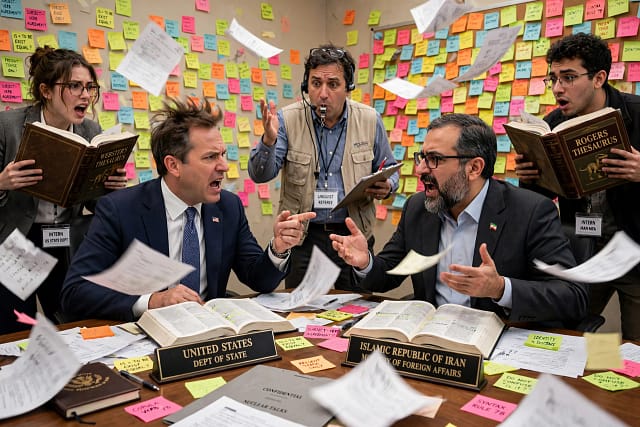
When Western diplomats finally emerge from marathon negotiation sessions with Iran, exhausted but triumphant, they often believe they’ve secured a binding agreement. They haven’t.
What they’ve actually signed is the opening move in an entirely different game—one where the rules are fluid, the language is deliberately vague, and patience isn’t just a virtue, it’s a weapon. Iranian negotiators are widely regarded by international relations experts as some of the most skilled, patient, and precise dealmakers in the world. But their genius isn’t in what they agree to. It’s in how they’ve already planned to reinterpret it.
Rather than viewing an agreement as a final, static contract, Tehran treats every signed document as a fluid baseline for the next phase of competition. This approach is deeply rooted in a blend of traditional bazaar-style haggling, historical grievances, and specific cultural and religious concepts that most Western negotiators barely understand—and certainly don’t anticipate.
The result? Iran consistently “loses” individual negotiating battles—and often the battlefield ones too—while positioning itself to win the longer war. Here’s how they do it.
1. The Art of Intentional Ambiguity: Building Escape Hatches Into Every Clause
If you’ve ever wondered why agreements with Iran seem to unravel almost immediately after the ink dries, the answer often lies in the language itself.
Iranian negotiators are masters of resisting rigid, clear-cut language or definitive timelines during the drafting phase. They don’t just tolerate vagueness—they actively engineer it. Every negotiation becomes a careful hunt for words with dual meanings, clauses that contain subtle loopholes, and phrasing abstract enough to support multiple interpretations.
The technique is deceptively simple: Push for flexible language during drafting. Then, once the agreement is signed, use that built-in vagueness to reinterpret obligations in ways that serve Iranian interests.
Consider the Joint Comprehensive Plan of Action (JCPOA)—the nuclear deal that took years to negotiate. Western diplomats celebrated specific restrictions on Iran’s nuclear program. Iranian negotiators celebrated something else entirely: the wiggle room embedded in phrases like “peaceful nuclear activities” and “proportionate response.”
When caught advancing a program or skipping a requirement, Tehran doesn’t admit wrongdoing. Instead, they argue that their actions are entirely compliant under their reading of the text. The conversation shifts from “Did Iran violate the agreement?” to “Who gets to interpret what the agreement actually means?”
The refocus is complete: Suddenly, Western powers find themselves defending their interpretation rather than enforcing Iranian compliance. The blame has been expertly redirected back onto the other parties for “misinterpreting” the deal.
This isn’t accidental. It’s architectural.
2. Structural Qualifiers (Khod’eh): The Promise That Isn’t Really a Promise
There’s a Persian concept called khod’eh—roughly translated as strategic deception or outmaneuvering through misdirection. In diplomatic contexts, it manifests as promises that sound completely cooperative on the surface but contain massive emergency exits.
The technique relies on heavily qualified statements that seem straightforward until you examine the fine print. A commitment will be made openly and enthusiastically, but it will be tethered to a restrictive qualifier that fundamentally changes its meaning.
During Iran’s early revolutionary period, leadership promised total freedom of expression—a commitment that sounded progressive and modern. But they always subtly appended the phrase “in accordance with Islamic principles.” Who defines those principles? Tehran does. Exclusively.
In modern treaties and Memorandums of Understanding, the same pattern repeats. Iranian negotiators will agree to transparency measures or inspection protocols, but always “subject to national security laws” or “consistent with sovereign rights.” These qualifiers sound reasonable—every nation has security concerns and sovereign prerogatives.
But here’s the trap: Iran reserves the unilateral right to determine when those qualifiers apply. A surprise inspection becomes a sovereignty violation. A verification measure becomes a national security threat. The commitment remains technically intact while becoming functionally meaningless.
The refocus is brilliant: Western negotiators think they’ve secured Iranian cooperation. What they’ve actually secured is Iranian agreement to cooperate when Iran decides cooperation serves Iranian interests—which is an entirely different thing.
The promise that isn’t really a promise becomes the foundation of the entire agreement.
3. Deliberate Aloofness and Stalling (Tanfih): Weaponizing the Calendar
In Western diplomacy, time is a resource to be managed efficiently. Political leaders face election cycles, media scrutiny, and domestic pressure to show results. Negotiations are conducted with urgency, driven by the need to demonstrate progress.
Iranian strategy flips this entirely, weaponizing patience through tanfih—the strategy of “judiciously doing nothing.”
Iranian negotiators will intentionally drag out talks for months or even years. They’ll muddy the waters with minor technical grievances. They’ll take weeks to respond to basic proposals. They’ll request additional clarification on points that were already clarified. They’ll introduce new concerns just as consensus seems within reach.
This isn’t incompetence or bureaucratic inefficiency. It’s deliberate strategic delay.
By slowing the clock, Iranian negotiators wait for the political landscape of their opponents to shift. A U.S. administration faces a midterm election. European governments deal with domestic crises. Public attention moves to other issues. The coalition of nations applying pressure begins to fracture as different countries develop different priorities.
The technique creates manufactured exhaustion. Western negotiators, desperate to show results before their political window closes, begin making concessions just to cross the finish line. The focus shifts entirely from tightening the language to simply getting something signed.
Iran’s negotiators, facing no comparable time pressure from their political system, can afford to wait. And wait. And wait.
When the deal finally comes together, it’s often because the Western side has compromised on key verification measures, softened enforcement mechanisms, or accepted vague language they would have rejected months earlier—all in the rush to beat the clock.
The refocus is complete: The negotiation stops being about the quality of the agreement and becomes about the political necessity of having an agreement to announce.
4. Aggressive Reciprocity and the ‘Victimization Narrative’: Flipping the Accountability Script
Iran brings a powerful historical narrative to every negotiating table: the story of a proud civilization repeatedly exploited, invaded, and undermined by Western powers.
This isn’t just background context. It’s a tactical weapon deployed with precision.
The technique works through aggressive reciprocity. When Western powers call out Iran for violating the spirit or letter of an agreement, Tehran immediately refocuses the conversation onto the other side’s historical or current shortcomings.
“The U.S. didn’t lift sanctions fast enough, so our technical violation is a justified response.” “European banks remained reluctant to do business with Iran, so we had no choice but to exceed enrichment limits.” “The West has interfered in our region for decades, so our defensive measures are entirely proportionate.”
The specific claims vary, but the pattern remains constant: Iran’s non-compliance becomes a justified reaction to Western bad faith.
This narrative draws on real historical grievances—the 1953 coup, decades of sanctions, Western support for Iraq during the Iran-Iraq War. These aren’t fabricated complaints. But in diplomatic negotiations, they’re deployed strategically to shift accountability.
The refocus is devastating: Instead of Iran defending its violations, Western powers find themselves defending their entire historical relationship with Iran. The conversation moves from “Did Iran comply with paragraph 7.3?” to “Has the West ever treated Iran fairly?”
It’s a moral trial where Iran positions itself as the victim and the West as the perpetrator. And in that framing, Iranian non-compliance stops looking like a violation and starts looking like justified resistance.
The spotlight has been completely redirected.
5. Exploiting the ‘Good Cop / Bad Cop’ Pluralism: The Moderate Who Needs Your Help
Iran’s political structure is uniquely complex, split between elected officials (the President and Foreign Minister) and the unelected religious and military elite (the Supreme Leader and the Islamic Revolutionary Guard Corps).
Most Western observers see this as a bug in the Iranian system. Iranian negotiators have turned it into a feature.
The technique is a sophisticated version of good cop/bad cop. Iranian diplomats—often highly educated, multilingual, and culturally sophisticated—present themselves as reasonable “moderates” who desperately want a deal. They’re charming, they’re pragmatic, they understand Western concerns.
But they always warn: “The hardliners back home are breathing down my necks. The IRGC opposes this deal. The Supreme Leader is skeptical. If you want this agreement to survive, you need to give me something I can take back to show we got real concessions.”
The refocus is subtle but powerful: Western diplomats stop negotiating strictly against Iranian national interests. Instead, they begin trying to “help” the Iranian moderates survive domestically.
The question shifts from “What serves our interests?” to “What can we give the moderates to strengthen their position?” Suddenly, Western negotiators are making unforced concessions—not because Iran demanded them, but because Western diplomats convinced themselves these concessions serve the larger goal of empowering Iranian reformers.
The irony? The “moderate” and the “hardliner” are often working toward the same strategic objectives. They just play different roles in extracting maximum concessions from the other side.
It’s political theater, and Western negotiators keep buying tickets.
6. Taarof (Cultural Deference as a Shield): Confusing Warmth with Weakness
There’s a uniquely Iranian cultural practice called taarof—a complex ritual of extreme politeness, hospitality, and indirectness that governs social interactions.
In everyday Iranian life, taarof means offering something multiple times even if you don’t mean it, refusing something multiple times even if you want it, and maintaining elaborate courtesies that can seem almost comically exaggerated to outsiders.
In diplomacy, taarof becomes something else entirely: a strategic disarmament tool.
Iranian negotiators deploy an incredibly genial, courteous, and respectful demeanor. They shower opponents with compliments. They host lavish dinners. They convey deep personal respect for their counterparts. They create an atmosphere of warmth, mutual understanding, and cultural exchange.
The technique works because it exploits a fundamental Western assumption: that personal rapport translates to strategic flexibility. Western negotiators, especially Americans, tend to believe that if you can establish a good personal relationship, compromise becomes easier.
Iranian negotiators understand this—and use it ruthlessly.
While the atmosphere feels warm and collaborative, the underlying strategic position remains completely rigid. The Iranian negotiator who praised your intelligence over dinner will offer zero additional flexibility on verification protocols the next morning. The charm is real; the concessions are not.
The refocus is psychological: Western negotiators confuse personal politeness with structural willingness to compromise. They interpret cultural hospitality as a signal of diplomatic flexibility. They mistake the warmth of taarof for the softness of their negotiating position.
It’s neither. It’s just good manners—weaponized.
The Strategy Behind the Tactics: Winning Wars by Losing Battles
Individually, each of these techniques is formidable. Together, they form a coherent strategic philosophy that treats international agreements not as endpoints but as ongoing competitions.
Iranian diplomacy operates on a fundamentally different timeline than Western diplomacy. While Western negotiators focus on securing the best possible deal in the current negotiation, Iranian negotiators focus on preserving maximum flexibility for future advantage.
They’ll accept unfavorable language in one clause if it creates ambiguity they can exploit later. They’ll make concessions on secondary issues to avoid clear commitments on primary ones. They’ll sign agreements they have no intention of fully implementing, knowing the real battle will be fought over interpretation and enforcement.
This is why Iran can “lose” individual negotiating battles while winning the longer war. The signed agreement isn’t the victory—it’s just another phase of the competition.
Western diplomats celebrate signing ceremonies. Iranian diplomats begin planning the reinterpretation.
The six tactics outlined above—intentional ambiguity, structural qualifiers, weaponized patience, victimization narratives, good cop/bad cop dynamics, and cultural disarmament—all serve the same ultimate purpose: transforming every agreement into a strategic advantage.
Understanding these tactics doesn’t make them easy to counter. Iran has been refining this approach for decades, drawing on centuries of bazaar culture, historical experience with foreign powers, and a political system that rewards long-term strategic thinking over short-term political wins.
But understanding is the first step. Western negotiators who recognize these patterns can at least stop falling for the same tricks. They can insist on clearer language. They can resist the pressure to rush. They can separate personal warmth from strategic concession.
They can, in short, stop treating negotiations with Iran like negotiations with anyone else.
Because they’re not. They’re the opening move in a much longer game—one where the rules are written in invisible ink, and the only way to win is to realize you’re still playing.