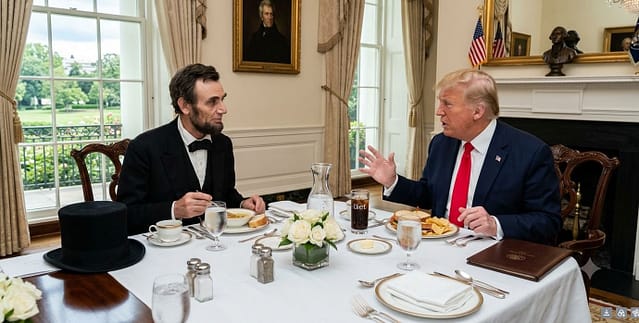
In the spring of 1861, as Abraham Lincoln assumed the presidency of a fracturing nation, the Charleston Mercury declared him a “reckless, unscrupulous, and unprincipled demagogue.” By 1863, opposition newspapers routinely depicted him wearing a crown, trampling the Constitution beneath military boots, his lanky frame caricatured as simian and grotesque. The Crisis, a prominent Copperhead newspaper in Ohio, called him “King Abraham I” and accused him of establishing “a dictatorship as absolute as that of any despot on earth.”
Fast-forward 150 years. In December 2016, as Donald Trump prepared to take office, The Washington Post adopted the motto “Democracy Dies in Darkness.” By 2020, major publications routinely featured op-eds with titles like “Trump’s Authoritarian Playbook” and “The Fascist Threat.” A giant inflatable “Baby Trump” balloon—depicting the president as an orange-skinned infant in diapers—became a fixture at protests worldwide. Historians and political scientists publicly debated whether American democracy could survive his presidency.
 The parallels are striking, even unsettling. Separated by more than a century and a half, two American presidents faced opposition movements that deployed remarkably similar rhetorical strategies: accusations of tyranny and dictatorship, visual caricatures designed to dehumanize and mock, apocalyptic warnings about constitutional collapse, and systematic efforts to delegitimize executive authority. The technologies differed—lithographs versus memes, broadsides versus tweets—but the fundamental tactics remained consistent.
This pattern raises profound questions about American political culture. Are these similarities merely coincidental, or do they reveal something essential about how democratic opposition operates during periods of intense polarization? Do such tactics reflect genuine institutional threats, or do they represent the predictable weaponization of crisis rhetoric for partisan advantage? By examining the parallel delegitimization campaigns against Lincoln and Trump, we can better understand the recurring patterns of American political conflict and what they reveal about the fragility—or resilience—of democratic legitimacy.
Structural Parallels: A Framework for Comparison
The opposition movements against Lincoln and Trump share a remarkably consistent architecture of delegitimization. Both deployed what might be called a “tyranny narrative”—a comprehensive rhetorical framework that portrayed the president as an existential threat to constitutional order, American identity, and democratic survival.
The Language of Autocracy
Lincoln’s critics favored monarchical terminology. He was “King Abraham I,” a “tyrant,” a “despot,” and a “usurper” who had seized powers never granted by the Constitution. The New York World, a Democratic newspaper, accused him of “more unlimited power than any constitutional executive ever wielded.” Southern publications went further, with the Richmond Examiner declaring that Lincoln’s government represented “a military despotism of the most odious character.”
Trump’s opponents employed updated but structurally identical language. He was labeled an “authoritarian,” a “wannabe dictator,” a “fascist,” and a “threat to democracy.” The rhetoric escalated throughout his presidency. Historian Timothy Snyder warned of “pre-fascism” in a widely-circulated essay. Former Secretary of State Madeleine Albright titled her 2018 book Fascism: A Warning, with Trump as the implicit subject. By 2024, President Biden himself used the term “semi-fascism” to describe Trump’s political movement.
The Constitutional Crisis Narrative
Both opposition movements centered their critique on alleged executive overreach. For Lincoln’s critics, the evidence was concrete: his suspension of habeas corpus in 1861, the military arrest of civilians (including Maryland legislators and newspaper editors), the imposition of martial law in border states, and the Emancipation Proclamation—which opponents viewed as an unconstitutional seizure of property rights. Chief Justice Roger Taney himself challenged Lincoln’s authority in Ex parte Merryman, arguing that only Congress could suspend habeas corpus.
Trump’s critics pointed to a different but parallel set of grievances: his extensive use of executive orders (particularly on immigration), his challenges to election outcomes in 2020, his rhetoric about deploying military force domestically, his firing of inspectors general and other oversight officials, and his resistance to congressional subpoenas. Legal scholars debated whether his actions constituted impeachable offenses, resulting in two actual impeachment proceedings—a historical rarity matched only by Andrew Johnson, Lincoln’s successor.
Visual Delegitimization
Perhaps most strikingly, both presidents became subjects of systematic visual mockery designed to strip away dignity and authority. Lincoln was drawn as an ape, a gorilla, a baboon, or a grotesque country bumpkin—the “Rail Splitter” whose rustic origins supposedly disqualified him from sophisticated leadership. His physical appearance—tall, gaunt, with prominent features—became a canvas for dehumanization.
Trump faced similar treatment adapted to modern sensibilities. His distinctive appearance—the orange-tinted skin, the elaborate hairstyle, the exaggerated facial expressions—became fodder for endless caricature. The “Baby Trump” balloon, which debuted in London in 2018 and subsequently appeared at protests worldwide, infantilized him as a diaper-clad toddler. Late-night comedy shows featured him as a buffoon, a narcissist, or a dangerous child with access to nuclear weapons.
Media Ecosystems
The dissemination methods differed by technology but served identical functions. Lincoln’s critics used lithographs, political broadsides, illustrated weeklies like Harper’s Weekly (which published both pro- and anti-Lincoln content), and partisan newspapers that reached mass audiences in both North and South. These images and texts circulated through a print culture that, while slower than digital media, achieved remarkable penetration in an era of high newspaper readership.
Trump’s opponents wielded social media platforms, digital memes that could go viral within hours, late-night television comedy with audiences in the millions, protest placards photographed and shared globally, and editorial cartoons that appeared simultaneously in print and online formats. The speed and reach differed exponentially, but the fundamental purpose—to create and circulate delegitimizing imagery—remained constant.
Executive Overreach: The Tyranny Accusation
The charge of executive tyranny formed the intellectual and constitutional core of both opposition movements. In each case, critics argued that the president had violated fundamental limits on executive power, transforming the presidency into something alien to American constitutional tradition.
Lincoln’s “Despotism”: Habeas Corpus and Military Authority
Lincoln’s suspension of habeas corpus in April 1861 ignited immediate controversy. The Constitution permits suspension “when in Cases of Rebellion or Invasion the public Safety may require it,” but does not specify which branch holds this power. Lincoln acted unilaterally, arguing that the rebellion’s urgency demanded immediate action before Congress could convene.
Chief Justice Taney’s response in Ex parte Merryman was scathing. Writing in his capacity as a circuit judge, Taney declared Lincoln’s action unconstitutional and accused him of violating his oath to faithfully execute the laws. Lincoln ignored the ruling, and the military continued to arrest and detain civilians suspected of Confederate sympathy or anti-war activities.
The scope was substantial. Estimates suggest that between 13,000 and 38,000 civilians were arrested and detained by military authorities during the war, many without formal charges or access to civilian courts. Prominent cases included Clement Vallandigham, an Ohio congressman and leading Copperhead who was arrested, tried by military commission, and banished to the Confederacy for making speeches critical of the war effort.
Democratic newspapers exploded with outrage. The Crisis declared: “The Constitution is abolished! The rights of the people are at an end! Military despotism reigns supreme!” The New York World accused Lincoln of “more startling invasions of personal liberty than any monarch of Europe would dare attempt.” Even some Republicans expressed discomfort, though most rallied to Lincoln’s defense on grounds of military necessity.
The Emancipation Proclamation intensified these accusations. Issued as a war measure under Lincoln’s authority as commander-in-chief, it declared free all enslaved people in rebel-held territory. Critics saw this as an unconstitutional seizure of property without due process and compensation. The New York Journal of Commerce called it “a gigantic usurpation, unparalleled for its despotic character in the history of constitutional government.” Democratic politicians argued that Lincoln had fundamentally altered the war’s purpose without congressional authorization, transforming a war to preserve the Union into a revolutionary crusade for racial equality.
Trump’s “Authoritarianism”: Executive Orders and Institutional Norms
Trump’s critics constructed a parallel narrative of executive overreach, though the specific mechanisms differed. Rather than wartime emergency powers, the focus centered on norm-breaking, institutional disruption, and what opponents characterized as authoritarian impulses constrained only by institutional resistance.
The travel ban executive orders of early 2017 set the tone. Critics characterized them as unconstitutional religious discrimination (the “Muslim ban”), implemented chaotically and in defiance of judicial oversight. When acting Attorney General Sally Yates refused to defend the orders, Trump fired her—a move opponents cited as evidence of authoritarian intolerance for dissent within the executive branch.
The pattern continued throughout his presidency. Trump’s declaration of a national emergency to redirect military construction funds toward border wall construction prompted accusations of constitutional overreach. His extensive use of acting officials to bypass Senate confirmation, his firing of inspectors general investigating his administration, and his resistance to congressional oversight all fed the narrative of a president systematically dismantling checks and balances.
The 2020 election aftermath crystallized these concerns. Trump’s refusal to concede, his pressure on state officials to “find” votes, his encouragement of the January 6th rally that preceded the Capitol breach, and his exploration of using military or emergency powers to remain in office led critics to describe an attempted “self-coup” or “autogolpe.” Legal scholars like Laurence Tribe declared that Trump had “declared war on the Constitution itself.” Historians including Jon Meacham and Michael Beschloss warned that American democracy faced its gravest crisis since the Civil War.
The rhetoric reached fever pitch. The Atlantic published “The Election That Could Break America” in September 2020, warning of potential authoritarian scenarios. After January 6th, the Washington Post editorial board wrote: “The nation witnessed an insurrection, encouraged by a president who has shown that his continued tenure in office poses a grave threat to U.S. democracy.” The House impeachment article accused Trump of “incitement of insurrection,” framing his actions as an assault on constitutional government itself.
Comparing the Accusations
The structural similarity is evident: both presidents faced accusations that they had exceeded constitutional bounds in ways that threatened to transform the presidency into something autocratic. The specific contexts differed enormously—Lincoln confronted an actual armed rebellion threatening national survival, while Trump operated in peacetime conditions with functioning (if polarized) institutions. Yet the rhetorical frameworks were nearly identical: the language of tyranny, dictatorship, and constitutional crisis; the invocation of founding principles under assault; the apocalyptic warnings about democratic collapse.
This parallel raises a critical question: Were these similar rhetorical strategies responding to genuinely similar threats, or does intense political polarization reliably produce tyranny accusations regardless of actual circumstances? The answer likely lies somewhere between these poles, but the pattern itself reveals something important about how American political opposition operates.
Physical Mockery and Visual Dehumanization
Beyond constitutional arguments, both opposition movements deployed systematic visual mockery designed to strip away presidential dignity and authority. These caricatures served multiple functions: they entertained supporters, expressed contempt, and—most importantly—delegitimized the president by portraying him as fundamentally unfit for office.
Lincoln as Ape: Racist Caricature and Class Contempt
The visual assault on Lincoln was vicious and often explicitly racist. Cartoonists and illustrators repeatedly drew him with exaggerated simian features—protruding jaw, long arms, stooped posture. These “ape” and “gorilla” caricatures drew on the era’s pseudo-scientific racism, which positioned a hierarchy of human types with Anglo-Saxons at the apex and Africans at the bottom, often depicted as closer to apes than to “civilized” humans.
By drawing Lincoln as ape-like, critics accomplished several goals simultaneously. They suggested he was intellectually inferior, closer to animals than to refined statesmen. They linked him visually to the enslaved people he sought to emancipate, implying a shared degraded status. And they mocked his humble origins—the “Rail Splitter” from the Kentucky-Illinois frontier who supposedly lacked the sophistication for high office.
One notorious 1864 cartoon showed Lincoln and a Black man examining each other, with the caption suggesting they were of the same species. Another depicted him as a jester or fool, wearing a crown and royal robes in mockery of his alleged pretensions to kingship. Southern publications were particularly savage. The Richmond Examiner described him as “a creature… of dull understanding, of low instincts, and of brutal manners.”
The physical mockery extended beyond simian imagery. His height, his gaunt frame, his large hands and feet, his rumpled clothing, his high-pitched voice—all became targets. Critics portrayed him as awkward, uncouth, a country bumpkin elevated beyond his natural station. The message was clear: this man’s very body testified to his unfitness for the presidency.
Trump as Infant: Narcissism and Incompetence
Modern caricatures of Trump operated differently but served similar delegitimizing functions. Rather than racist pseudo-science, they drew on psychological frameworks—narcissism, impulsivity, emotional immaturity. The dominant visual theme portrayed Trump not as subhuman but as pre-adult: a baby, a toddler, a spoiled child with dangerous toys.
The “Baby Trump” balloon became the iconic image. First flown in London during Trump’s 2018 visit, the 20-foot inflatable depicted him as an orange-skinned infant in a diaper, clutching a mobile phone, his mouth open in a wail. The image spread globally, appearing at protests in Paris, Buenos Aires, and cities across the United States. Its message was unmistakable: this president was emotionally and intellectually infantile, throwing tantrums rather than governing responsibly.
Editorial cartoonists elaborated the theme endlessly. Trump appeared as a baby in a high chair, throwing food. As a toddler with a nuclear football toy. As a child scribbling with crayons on important documents. The visual vocabulary emphasized impulsivity, narcissism, short attention span, and dangerous incompetence.
His physical appearance provided endless material. The orange-tinted skin (whether from tanning beds or makeup) became a signature element of caricature, often exaggerated to absurd extremes. His distinctive hairstyle—elaborate, gravity-defying, of ambiguous color—appeared in countless variations, sometimes depicted as a separate entity with its own agency. His facial expressions—the pursed lips, the squinting eyes, the exaggerated gestures—were amplified to suggest buffoonery or menace.
Late-night comedy shows weaponized these visual elements. Alec Baldwin’s Saturday Night Live portrayal emphasized petulance and stupidity. Stephen Colbert, Jimmy Kimmel, and others incorporated Trump mockery into their nightly monologues, reaching audiences in the millions. The cumulative effect was a sustained visual assault on presidential dignity, portraying Trump as fundamentally ridiculous and unfit.
The Function of Visual Delegitimization
These caricatures served purposes beyond entertainment. By portraying the president as physically grotesque (Lincoln) or emotionally infantile (Trump), opponents suggested that unfitness was visible, embodied, undeniable. The mockery operated at a pre-rational level—before policy arguments or constitutional debates, the images declared: Look at this person. Does this look like a president?
The dehumanization was deliberate. By drawing Lincoln as an ape, critics suggested he was less than fully human, unworthy of respect or deference. By drawing Trump as a baby, critics suggested he was less than fully adult, incapable of the judgment and restraint that leadership requires. In both cases, the visual rhetoric aimed to make opposition feel not just justified but necessary—how could such a figure be permitted to wield presidential power?
Yet the tactics also reveal something troubling about political opposition. Both campaigns relied on ad hominem attacks that substituted personal mockery for substantive critique. They encouraged contempt rather than reasoned disagreement. And they normalized a level of disrespect for the office that, regardless of the occupant’s merits, potentially weakened the presidency as an institution.
Media Evolution: From Lithographs to Memes
The technologies of delegitimization evolved dramatically between the 1860s and the 2020s, yet the fundamental strategies remained remarkably consistent. Understanding this evolution illuminates both the continuities and the transformations in how political opposition operates.
The 19th Century Print Culture
Lincoln’s critics worked within a robust but technologically limited media ecosystem. Political lithographs—printed images produced from stone or metal plates—could be reproduced in the thousands and sold cheaply or distributed free. These images appeared in shop windows, taverns, and homes, creating a visual culture of political commentary accessible even to the illiterate.
Broadsides—single-sheet publications combining text and image—served as the era’s equivalent of viral content. They could be printed quickly in response to events, posted on walls and fences, and passed hand-to-hand. During the 1864 election, anti-Lincoln broadsides flooded Northern cities, depicting him as tyrant, fool, or racial amalgamationist.
Illustrated weeklies like Harper’s Weekly, Frank Leslie’s Illustrated Newspaper, and Vanity Fair reached mass audiences. Harper’s alone had a circulation of over 100,000 by 1860—remarkable for the era—and each copy was typically read by multiple people. These publications featured elaborate political cartoons by artists like Thomas Nast (who generally supported Lincoln but criticized many politicians) and others who opposed him.
Partisan newspapers formed the backbone of political communication. Most newspapers were explicitly affiliated with political parties, and their editorial content reflected partisan commitments without pretense of objectivity. Democratic papers like the New York World, Chicago Times, and Crisis published relentless attacks on Lincoln, while Republican papers like the New York Tribune and Chicago Tribune defended him. The result was a deeply polarized media environment where readers could inhabit entirely separate informational universes.
The limitations were significant. Production required time and resources. Distribution depended on physical transportation—rail, ship, horse. An image or article might take days or weeks to reach distant audiences. Yet within these constraints, the system achieved remarkable reach and impact. The visual and rhetorical assault on Lincoln penetrated deeply into public consciousness, shaping how millions of Americans understood their president.
The 21st Century Digital Ecosystem
Trump’s critics operated in a radically different technological environment, yet deployed it toward familiar ends. Digital memes—images with text overlays, easily created and infinitely reproducible—became the era’s lithographs. A clever or striking meme could reach millions within hours, shared across Facebook, Twitter, Instagram, and Reddit. The “Baby Trump” image, for instance, circulated globally within days of the balloon’s first appearance.
Social media platforms transformed the speed and scale of political communication. A critical tweet could be retweeted thousands of times in minutes. A protest photo could appear simultaneously on millions of screens worldwide. The barriers to entry collapsed—anyone with a smartphone could create and distribute political content, democratizing the means of propaganda production.
Late-night television comedy shows functioned as the era’s illustrated weeklies, but with vastly larger audiences and more immediate impact. The Daily Show, The Late Show with Stephen Colbert, Last Week Tonight with John Oliver, and Saturday Night Live reached millions of viewers and generated additional millions of views through online clips. Their Trump mockery—visual, verbal, and conceptual—shaped public perception with a reach that 19th-century publications could never achieve.
Traditional editorial cartoons continued, but now appeared simultaneously in print and online, shared across social media, and incorporated into digital memes. Cartoonists like Ann Telnaes, Mike Luckovich, and Nick Anderson produced images that circulated far beyond their newspapers’ traditional readership.
The result was a media environment of unprecedented speed, reach, and saturation. A Trump critic could encounter anti-Trump content dozens or hundreds of times daily across multiple platforms. The sheer volume and repetition of delegitimizing imagery and rhetoric created an immersive experience impossible in earlier eras.
Continuity and Transformation
Yet beneath the technological transformation, the fundamental strategies remained constant. Both eras featured:
- Visual caricature designed to mock and dehumanize
- Partisan media ecosystems where supporters and opponents inhabited separate informational worlds
- Rapid response to events (within the technological constraints of each era)
- Mass distribution of delegitimizing content
- Mixture of humor and outrage to engage audiences emotionally
- Cumulative effect of repeated exposure shaping public perception
The key difference was scale and speed. What took weeks in the 1860s took hours in the 2020s. What reached thousands then reached millions now. But the underlying logic—use visual and rhetorical tools to delegitimize the president, distribute widely through available media, create an alternative narrative of illegitimacy—remained essentially unchanged.
This continuity suggests that the tactics of political opposition are less dependent on technology than we might assume. New tools enable new efficiencies, but the fundamental strategies reflect enduring features of democratic conflict: the need to mobilize supporters, the utility of mockery and outrage, the power of visual imagery to bypass rational argument and appeal directly to emotion and intuition.
National Identity and Apocalyptic Rhetoric
Both opposition movements deployed narratives of national crisis that transcended policy disagreements to frame the presidency itself as an existential threat to American identity and survival. This apocalyptic rhetoric served to justify extraordinary opposition and to cast political conflict as a struggle for the nation’s soul.
Lincoln’s Critics: The Destruction of the Union
For Lincoln’s opponents, particularly in the South but also among Northern Copperheads, his presidency represented the destruction of the constitutional Union and the imposition of a revolutionary new order. This narrative operated on multiple levels.
First, the constitutional argument: Lincoln had violated fundamental limits on federal power, transforming a government of enumerated powers into a centralized despotism. The suspension of habeas corpus, military arrests, and other wartime measures were portrayed not as temporary necessities but as permanent transformations. The Richmond Examiner declared that Lincoln’s government was “no longer the government established by our fathers, but a new thing—a revolutionary despotism.”
Second, the racial and social argument: The Emancipation Proclamation and the eventual push for the 13th Amendment represented a radical overturning of the existing social order. Democratic newspapers warned of “miscegenation” (a term invented during the 1864 campaign), racial amalgamation, and the destruction of white civilization. The Crisis published lurid predictions of racial violence and social chaos following emancipation. This rhetoric appealed to the racism endemic in both North and South, framing Lincoln’s policies as threats to white identity and supremacy.
Third, the economic argument: The war itself, with its unprecedented costs in blood and treasure, was portrayed as an unnecessary catastrophe brought on by Lincoln’s refusal to compromise. By 1864, with over 600,000 dead and the war’s end not yet in sight, Copperhead newspapers asked whether preserving the Union was worth such slaughter. They portrayed Lincoln as a fanatic willing to destroy the nation to satisfy his own ambitions or ideological commitments.
The 1864 Democratic platform declared that “after four years of failure to restore the Union by the experiment of war… justice, humanity, liberty, and the public welfare demand that immediate efforts be made for a cessation of hostilities.” This framed Lincoln’s determination to continue the war as itself a threat to the nation’s welfare—better to accept separation than to continue the bloodshed.
Southern rhetoric was even more apocalyptic. Lincoln was portrayed as a Black Republican radical determined to destroy Southern civilization, confiscate property, incite slave rebellion, and impose racial equality by force. The war itself was framed as a defense of constitutional liberty against tyrannical aggression. Jefferson Davis’s rhetoric consistently portrayed the Confederacy as the true heir to the American Revolution, fighting against a despotic central government just as the founders had fought against King George III.
Trump’s Critics: The Threat to Democracy
Trump’s opponents deployed structurally similar apocalyptic rhetoric, adapted to contemporary concerns about democratic backsliding and authoritarian populism. The narrative positioned Trump as an existential threat to American democracy, constitutional norms, and the liberal international order.
The rhetoric began even before his inauguration. In November 2016, The New Yorker published “An American Tragedy,” declaring Trump’s election “a tragedy for the American republic, a tragedy for the Constitution, and a triumph for the forces, at home and abroad, of nativism, authoritarianism, misogyny, and racism.” This set the tone: Trump’s presidency was not merely undesirable but catastrophic, a fundamental break with American democratic tradition.
As his presidency progressed, the apocalyptic rhetoric intensified. Historians and political scientists warned of democratic erosion. Steven Levitsky and Daniel Ziblatt’s How Democracies Die (2018) became a bestseller, with Trump as the implicit subject. Timothy Snyder’s On Tyranny: Twenty Lessons from the Twentieth Century (2017) drew parallels between Trump’s rhetoric and the rise of European fascism. The message was clear: American democracy faced threats comparable to those that destroyed democracies in the 1930s.
The Russia investigation fed narratives of foreign influence and compromised sovereignty. The Mueller Report’s findings—that Russia had interfered in the 2016 election and that Trump had attempted to obstruct the investigation—were framed by critics as evidence of a president who had betrayed national interests for personal gain. The first impeachment, focused on Ukraine, reinforced this narrative: Trump was willing to corrupt American foreign policy and undermine national security for electoral advantage.
The 2020 election and its aftermath brought the apocalyptic rhetoric to a crescendo. Trump’s refusal to commit to accepting the election results, his baseless claims of widespread fraud, his pressure on state officials and the Justice Department, and his encouragement of the January 6th rally were portrayed as an attempted coup. Legal scholar Laurence Tribe wrote that Trump had “declared war on the Constitution.” Historian Michael Beschloss stated that American democracy faced its greatest crisis since the Civil War—an explicit parallel to Lincoln’s era, but with Trump cast as the threat rather than the defender.
The rhetoric extended beyond Trump personally to his movement. Critics warned of “Trumpism” as an ongoing threat—a form of authoritarian populism that would outlast Trump himself. The January 6th Capitol breach was framed not as an isolated incident but as a symptom of deeper democratic decay, with Trump as the catalyst or accelerant.
Comparing the Apocalyptic Narratives
The structural parallels are striking. Both opposition movements:
- Framed the presidency as existential threat rather than policy disagreement
- Invoked constitutional crisis and the destruction of fundamental American principles
- Deployed historical parallels to tyranny, dictatorship, or democratic collapse
- Predicted catastrophic consequences if the president continued in office
- Questioned the legitimacy of the president’s authority
- Portrayed opposition as patriotic duty rather than partisan politics
The specific content differed—racial order versus democratic norms, Union preservation versus constitutional checks and balances—but the rhetorical structure remained constant. In both cases, opponents argued that the stakes transcended normal political competition. This was not about tax policy or trade agreements; it was about the survival of the American experiment itself.
This apocalyptic framing served important functions for opposition movements. It justified extraordinary measures—impeachment, resistance, norm-breaking in service of norm-defense. It mobilized supporters by elevating the conflict beyond mundane politics to a struggle for national survival. And it delegitimized compromise or accommodation—how can one compromise with tyranny or negotiate with a threat to democracy itself?
Yet the rhetoric also carried costs. By framing every presidency as an existential crisis, it potentially devalued the currency of democratic alarm. If every president is a tyrant, the term loses meaning. If every election is the most important in history, the claim becomes hollow. The apocalyptic rhetoric of both eras raises questions about whether American political culture has a tendency toward catastrophizing—and whether this tendency itself poses risks to democratic stability.
What the Patterns Reveal: Opposition Tactics and Democratic Polarization
The remarkable parallels between opposition to Lincoln and opposition to Trump are not coincidental. They reveal consistent patterns in how American political opposition operates during periods of intense polarization, and they raise important questions about the relationship between rhetoric and reality in democratic conflict.
The Toolkit of Delegitimization
Both opposition movements drew from a common toolkit of delegitimization tactics:
- Authoritarian labeling: Framing the president as tyrant, dictator, despot, or fascist—language that places him outside the bounds of legitimate democratic leadership.
- Constitutional crisis narrative: Arguing that the president has violated fundamental constitutional limits, transforming the presidency into something alien to American tradition.
- Visual dehumanization: Using caricature and mockery to strip away dignity and suggest unfitness at a visceral, pre-rational level.
- Apocalyptic framing: Portraying the presidency as an existential threat to national identity, survival, or core values.
- Media saturation: Using available technologies to ensure repeated exposure to delegitimizing messages across multiple platforms.
- Legitimacy questioning: Challenging not just policies but the fundamental right to hold office.
The consistency of these tactics across vastly different historical contexts suggests they represent something like a grammar of democratic opposition—a set of available moves that opposition movements reliably deploy when conflict intensifies beyond normal partisan competition.
Polarization and Rhetorical Escalation
The parallels also illuminate the relationship between polarization and rhetorical escalation. Both the 1860s and the 2010s-2020s were periods of extreme political polarization, characterized by:
- Partisan media ecosystems where supporters and opponents consumed different information
- Geographic and cultural sorting that reduced cross-partisan contact and understanding
- High-stakes conflicts over fundamental questions of national identity and values
- Mutual delegitimization where each side viewed the other as existential threat
- Erosion of shared norms about acceptable political behavior and rhetoric
In such environments, the toolkit of delegitimization becomes not just available but almost inevitable. When the stakes are framed as existential, when opponents are viewed as threats rather than fellow citizens with different views, the logic of escalation takes over. If the other side is willing to destroy the country, then extraordinary opposition becomes not just justified but necessary.
This creates a self-reinforcing cycle. Apocalyptic rhetoric justifies norm-breaking opposition. Norm-breaking opposition confirms the other side’s apocalyptic narrative. Each side’s worst fears about the other become self-fulfilling prophecies.
The Question of Proportionality
The parallels raise a difficult question: Were these similar rhetorical strategies responding to genuinely similar threats, or does intense polarization reliably produce tyranny accusations regardless of actual circumstances?
The contexts differed enormously. Lincoln confronted an actual armed rebellion, a war that killed 2% of the American population, and the existential question of whether democratic government could survive internal division. The suspension of habeas corpus and military arrests, whatever their constitutional status, occurred in the context of genuine national emergency.
Trump governed in peacetime, with functioning (if polarized) institutions, regular elections, and no comparable crisis. His norm-breaking was real—the refusal to release tax returns, the attacks on media and judiciary, the resistance to oversight, the post-election behavior—but occurred within a system that continued to function. Courts ruled against him and those rulings were enforced. Congress impeached him twice. The 2020 election removed him from office, and despite his resistance, the transition occurred.
Yet from the perspective of Trump’s critics, the threat was no less real for being novel. They argued that democratic erosion happens gradually, through the accumulation of norm violations that weaken institutions over time. By the time a would-be authoritarian has consolidated power, it’s too late to resist. Therefore, early and vigorous opposition—including apocalyptic rhetoric—was necessary to prevent a slide into authoritarianism.
This debate cannot be easily resolved. It reflects fundamentally different assessments of threat and proportionality. But the historical parallel suggests that we should be cautious about accepting apocalyptic rhetoric at face value. The fact that similar rhetoric appears in vastly different contexts suggests it may tell us more about the psychology of polarization than about objective threat levels.
The Institutional Question
The parallels also raise questions about institutional resilience. Lincoln’s critics warned that his actions would permanently transform the presidency into an imperial office. Yet after the war, presidential power receded. The Reconstruction-era Congress reasserted legislative supremacy, and subsequent presidents operated within traditional constraints (until the next crisis).
Similarly, Trump’s critics warned that his norm-breaking would permanently damage democratic institutions. Yet those institutions—courts, Congress, the civil service, the military, the electoral system—largely held. The 2020 election proceeded despite unprecedented challenges. The January 6th breach was repelled and the certification completed. The transition occurred.
This suggests that American institutions may be more resilient than apocalyptic rhetoric assumes. The system has weathered previous periods of intense conflict and presidential norm-breaking. The question is whether each cycle of polarization and delegitimization weakens institutions incrementally, or whether the system’s self-correcting mechanisms remain robust.
The Cost of Delegitimization
Finally, the parallels highlight the costs of sustained delegitimization campaigns. By portraying presidents as tyrants and existential threats, opposition movements may:
- Weaken the presidency as an institution, making it harder for any president to govern effectively
- Normalize disrespect and contempt in political discourse, coarsening democratic culture
- Reduce space for compromise, since one cannot compromise with tyranny
- Desensitize citizens to genuine threats, through the “boy who cried wolf” effect
- Increase political violence risk, by framing opposition as existential struggle
- Undermine democratic legitimacy, by teaching citizens that election results don’t confer legitimate authority
These costs are real regardless of whether the apocalyptic rhetoric is justified. Even if Trump genuinely posed authoritarian threats, the tactics used to oppose him may have long-term consequences for democratic culture and institutional stability.
Conclusion: Democracy, Legitimacy, and the Rhetoric of Crisis
The parallel delegitimization campaigns against Abraham Lincoln and Donald Trump reveal uncomfortable truths about American democratic culture. Separated by more than 150 years, facing vastly different circumstances, two presidents encountered opposition movements that deployed remarkably similar tactics: authoritarian labeling, constitutional crisis narratives, visual dehumanization, apocalyptic rhetoric, and systematic efforts to question legitimacy.
These parallels suggest that intense political polarization produces predictable patterns of opposition, regardless of the specific issues at stake or the actual threat level posed by the president. The toolkit of delegitimization—tyrant accusations, mocking caricatures, existential framing—appears to be a recurring feature of American political conflict when polarization reaches critical levels.
This pattern raises profound questions. If similar rhetoric appears in contexts as different as the Civil War and the Trump presidency, what does it actually tell us? Does it reveal genuine threats to democratic order, or does it reflect the predictable weaponization of crisis rhetoric for partisan advantage? The answer likely varies by case, but the pattern itself suggests we should approach apocalyptic political rhetoric with some skepticism.
The historical record offers both reassurance and warning. American institutions survived Lincoln’s wartime measures and returned to normal constitutional operation. They also survived Trump’s norm-breaking and successfully conducted the 2020 election and transition. This suggests resilience. Yet each cycle of polarization and delegitimization may incrementally weaken democratic culture and institutional legitimacy. The cumulative effect of repeated crisis rhetoric—if every president is a tyrant, if every election is existential—may be to hollow out the shared commitments that make democratic competition possible.
The comparison also highlights the costs of political opposition that relies heavily on personal mockery and dehumanization. The ape caricatures of Lincoln and the baby balloon of Trump both served to delegitimize through contempt rather than argument. Such tactics may be effective at mobilizing supporters and expressing outrage, but they also coarsen political culture and reduce space for the mutual respect that democratic citizenship requires.
Perhaps most importantly, the parallels remind us that our own moment is not as unprecedented as it feels. Americans in the 1860s also believed they faced an existential crisis, that their president was a tyrant, that democracy itself hung in the balance. They were not entirely wrong—the Civil War was indeed an existential crisis—but their apocalyptic rhetoric about Lincoln personally proved exaggerated. History vindicated Lincoln as one of America’s greatest presidents, the man who preserved the Union and ended slavery.
Will history offer a similar verdict on our current conflicts? It’s too soon to know. But the historical parallel suggests humility about our own certainties. The tactics of delegitimization are consistent across time; the actual threats vary enormously. Distinguishing between genuine democratic crisis and the predictable rhetoric of polarization remains one of the most difficult challenges of democratic citizenship.
What we can say with confidence is that the pattern itself—the recurring cycle of polarization, delegitimization, and apocalyptic rhetoric—poses its own risks to democratic stability. A political culture that routinely frames opposition in existential terms, that treats every president as a potential tyrant, that relies on mockery and contempt rather than reasoned disagreement, is a political culture under strain.
The question facing Americans today is not just whether any particular president poses authoritarian threats, but whether our political culture retains the capacity for the kind of disagreement that doesn’t devolve into delegitimization. Can we oppose presidents vigorously without portraying them as tyrants? Can we criticize policies sharply without dehumanizing the people who propose them? Can we compete for power intensely while still accepting the legitimacy of those who win?
The parallel campaigns against Lincoln and Trump suggest these questions are not new. They are, in fact, perennial challenges of democratic life, especially acute during periods of intense polarization. How we answer them—whether we can break the cycle of escalating delegitimization or whether we remain trapped in it—may determine whether American democracy proves as resilient in the 21st century as it did in the 19th.