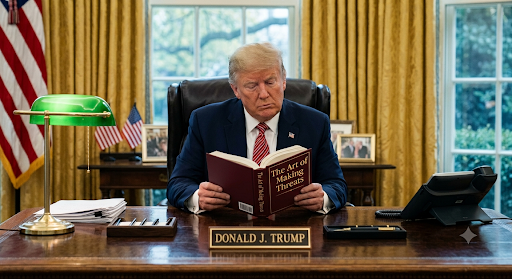
By the numbers, President Donald Trump may have threatened Iran more times than he actually bombed it.
Since Operation Epic Fury launched on February 28, 2026, Trump has issued what experts estimate to be dozens—perhaps even hundreds—of verbal and written threats against the Islamic Republic. They’ve come via Truth Social posts, televised addresses, press briefings, and off-the-cuff remarks to reporters. They’ve targeted everything from Iranian power plants to oil wells, from naval bases to the Supreme Leader himself.
The actual bombs? Those numbered in the thousands during the initial 38-day campaign. But the threats to drop bombs? Those may have been even more numerous.
This raises a provocative question about modern warfare and presidential communication: In an era of social media and 24/7 news cycles, can the threat of military action become as central to strategy as the action itself? And when does aggressive rhetoric cross the line from diplomatic pressure to potential war crimes?
What Is Operation Epic Fury?
To understand Trump’s threat campaign, it’s essential to grasp what Operation Epic Fury actually accomplished on the ground.
Launched in late February 2026, Epic Fury was a massive U.S.-Israeli military operation designed to permanently degrade Iran’s ability to project power across the Middle East and develop nuclear weapons. The campaign lasted approximately 38 days, running through early April, and represented one of the most intensive bombing campaigns since the 2003 invasion of Iraq.
The operation’s primary targets included:
- Ballistic missile and drone facilities across Iran’s military-industrial complex
- Naval assets, particularly in the Persian Gulf and near the Strait of Hormuz
- Nuclear-related infrastructure, including enrichment facilities and research centers
- Defense industry sites manufacturing missiles, drones, and other weapons systems
- Command and control centers, including leadership targets
The most dramatic strike came early in the campaign when Supreme Leader Ayatollah Ali Khamenei was killed in a precision attack. His death sent shockwaves through Iran’s political establishment and fundamentally altered the trajectory of the conflict.
By early April, a fragile ceasefire had taken hold. But as subsequent months would prove, the end of major combat operations didn’t mean the end of Trump’s threats—far from it.
The Threat Taxonomy: Breaking Down Trump’s Warnings
Trump’s threats against Iran fall into several distinct categories, each escalating in severity and specificity as the conflict evolved.
Early Operation Warnings (February-March 2026)
In the opening weeks of Epic Fury, Trump’s threats were broad but backed by immediate military action. He framed the strikes as responses to “imminent threats” and called on the Iranian people to overthrow their government.
“The Iranian military has a choice,” Trump said in a March 2 address. “Surrender now, or face certain death. We will not stop until every threat to American lives is eliminated.”
These early threats were notable because they directly preceded or accompanied actual bombing campaigns. The rhetoric and the reality were aligned—when Trump threatened action, bombs followed within hours or days.
Infrastructure Ultimatums (March-April 2026)
As the military campaign progressed and ceasefire negotiations began, Trump’s threats took a darker turn. He began targeting civilian and economic infrastructure, using the threat of widespread destruction as leverage in negotiations.
The threats were specific and chilling:
- “Obliterate” Iran’s largest power plants, starting with the biggest
- Destroy oil wells and the Kharg Island oil export terminal
- Bomb bridges connecting major cities
- Strike desalination plants providing drinking water to coastal populations
These threats were explicitly tied to demands that Iran reopen the Strait of Hormuz to international shipping and agree to permanent restrictions on its nuclear program.
Trump’s Truth Social posts from this period read like a menu of potential devastation. On March 28, he wrote: “Iran has 24 hours to comply. After that, their power grid goes dark. Then their oil. Then their water. They will BEG for a deal.”
The “Civilization Will Die” Moment
The most extreme rhetoric came on April 7, 2026, as ceasefire talks appeared to stall. In a late-night Truth Social post that shocked even some of his allies, Trump wrote:
“A whole civilization will die tonight, never to be brought back again” if Iran didn’t accept his terms.
The post sparked immediate international condemnation. UN Secretary-General António Guterres called it “language incompatible with international humanitarian law.” Human rights organizations warned that threats to destroy civilian infrastructure could constitute war crimes under the Geneva Conventions.
Notably, Trump pulled back from this particular threat as negotiations resumed. No massive strike materialized that night. But the threat itself had served its purpose—demonstrating the scale of destruction Trump was willing to contemplate, and perhaps convincing Iranian negotiators that further resistance was futile.
Post-Ceasefire Escalations (June-July 2026)
The ceasefire that took hold in early April proved fragile. By June, Trump was declaring it “over” and authorizing renewed strikes in response to Iranian actions in the Strait of Hormuz.
His threats during this period included:
- “Hit them hard” with renewed bombing campaigns
- Seize Iranian islands in the Persian Gulf
- Implement a total naval blockade
- Launch “major operations” exceeding the scale of the original Epic Fury campaign
Each threat was calibrated to specific Iranian actions—a mine laid in shipping lanes, a drone flight near U.S. vessels, a statement from Iranian officials that Trump deemed insufficiently conciliatory.
The Assassination Threat (July 11, 2026)
Trump’s most personal and potentially most dangerous threat came on July 11, following Ayatollah Khamenei’s funeral, where crowds chanted anti-American slogans. Intelligence reports also suggested Iranian plots to assassinate Trump in retaliation for Khamenei’s death.
Trump’s response was characteristically blunt:
“1000 Missiles are Locked and Loaded… with thousands more to immediately follow” if Iran attempted to harm him. He added that the U.S. military was prepared for “one year… to completely decimate and destroy all areas of Iran.”
This threat stood out for several reasons. First, it was explicitly personal—Trump was defending himself, not just American interests. Second, it contemplated a year-long campaign of total destruction, far exceeding anything attempted during Epic Fury. Third, it suggested no target in Iran would be off-limits.
Military analysts noted that the U.S. doesn’t actually have thousands of missiles “locked and loaded” on Iranian targets at any given moment, suggesting the threat was more rhetorical than operational. But that didn’t diminish its impact on Iranian decision-making.
Peace Through Strength: The Strategy Behind the Threats
Trump and his advisors consistently framed the threat campaign as “peace through strength”—the idea that overwhelming displays of potential force would compel adversaries to negotiate rather than fight.
National Security Advisor Mike Waltz explained the approach in a June interview: “Every time the President issues a warning, Iran has to take it seriously because they’ve seen what happens when they don’t. That’s not warmongering—that’s deterrence.”
The pattern was consistent: Trump would issue a threat with a specific deadline, then pause or adjust it as negotiations progressed. Threats were calibrated to extract concessions—reopening the Strait, releasing detained Americans, accepting nuclear inspections, or agreeing to talks.
In this framework, threats weren’t preludes to action but alternatives to it. The goal was to make the threat so credible and so severe that Iran would comply rather than call the bluff.
This approach had historical precedents. President Richard Nixon’s “madman theory” during the Vietnam War similarly relied on convincing adversaries that he might do anything, including use nuclear weapons. President Ronald Reagan’s military buildup and aggressive rhetoric toward the Soviet Union in the 1980s was credited by some with hastening the end of the Cold War.
But critics argued Trump’s approach was reckless in the social media age, where a late-night post could spark international crises before cooler heads could prevail.
The War Crimes Question
International law experts raised serious concerns about Trump’s infrastructure threats, particularly those targeting power plants, water facilities, and other civilian necessities.
The Geneva Conventions prohibit attacks on “objects indispensable to the survival of the civilian population.” Deliberately destroying water treatment facilities or power grids serving civilian areas could constitute war crimes, even if those facilities also serve military purposes.
Professor Mary Ellen O’Connell of Notre Dame Law School told reporters in April: “Threatening to destroy ‘a whole civilization’ isn’t just rhetoric—it’s a threat to commit genocide. Even if never carried out, such threats violate the spirit of international humanitarian law and undermine global norms against targeting civilians.”
The Trump administration’s response was that all threats were directed at the Iranian regime, not the Iranian people, and that infrastructure targets were legitimate because they supported Iran’s military capabilities. Officials also noted that threats aren’t the same as actions, and that Trump’s willingness to pull back from threats demonstrated restraint, not recklessness.
The legal debate remained unresolved, but it highlighted how Trump’s threat campaign operated in a gray zone between psychological warfare and potential criminality.
Why So Many Threats?
Several factors explain the extraordinary frequency of Trump’s threats against Iran:
Negotiating Leverage: Each threat was designed to extract specific concessions. The more threats, the more pressure points Trump could apply in negotiations.
Deterrence: Frequent threats kept Iran off-balance and deterred retaliation for Khamenei’s death and other strikes. If Iran believed Trump might destroy their power grid at any moment, they’d be less likely to risk escalation.
Domestic Politics: Trump’s base responded enthusiastically to tough talk on Iran. Threats played well politically, even when not followed by action.
Media Strategy: In the 24/7 news environment, threats generated headlines and kept Trump at the center of the narrative. Each Truth Social post became a news cycle.
Personal Style: Trump has always favored bold, aggressive rhetoric. His business career was built on high-stakes negotiations where threats and bluster were standard tactics.
Low Cost: Unlike actual military strikes, threats cost nothing to issue and could be walked back if circumstances changed. They were a low-risk, high-reward tool.
The Counting Problem
Determining exactly how many threats Trump issued is surprisingly difficult. What counts as a distinct threat?
If Trump posts “Iran will pay a heavy price” on Truth Social, then repeats it in a press conference an hour later, is that one threat or two? If he threatens power plants on Monday and oil facilities on Tuesday, are those separate threats or part of a single infrastructure threat campaign?
Analysts have attempted various methodologies:
- Distinct public statements: Counting each speech, post, or interview where threats appear (likely 50-100+ instances)
- Unique threat categories: Counting different types of targets or actions threatened (perhaps 15-20 categories)
- Specific ultimatums: Counting only threats with explicit deadlines or conditions (maybe 10-15 instances)
By any measure, the threats numbered in the dozens at minimum. Some analysts tracking Trump’s Truth Social account alone counted over 40 posts containing explicit threats between February and July 2026.
Compare this to the actual military strikes: Operation Epic Fury involved thousands of individual munitions dropped on hundreds of targets over 38 days. Post-ceasefire strikes added dozens more. But these were concentrated in specific operational periods, while threats were continuous.
Rhetoric vs. Reality: What the Numbers Reveal
So do threats outnumber bombs in Epic Fury? The answer depends on how you count.
If we’re counting individual munitions versus individual threat statements, bombs likely win—thousands of missiles and bombs versus dozens of distinct threats.
But if we’re counting threat events versus strike events, the calculus shifts. Trump issued threats on dozens of separate occasions across five months, while actual strikes were concentrated in a few major operational periods.
More importantly, the threats occupied far more of Trump’s public communication than the strikes themselves. His social media feed, his speeches, his press interactions—all were dominated by threats and warnings. The actual bombing campaigns, while devastating, were largely conducted by the military with less direct presidential involvement in day-to-day operations.
This reveals something significant about modern presidential warfare: the communication strategy can be as intensive as the military strategy. Trump spent as much time—perhaps more—threatening Iran as he did actually attacking it.
Whether this approach was effective remains debatable. Iran did agree to ceasefires and negotiations, suggesting the threats had impact. But the fragility of those agreements and the need for repeated threats suggest Iran wasn’t fully deterred.
What’s clear is that Trump pioneered a new model of presidential communication during military operations—one where the threat itself becomes a weapon, deployed as frequently and as publicly as the bombs themselves.
In the age of social media warfare, sometimes the loudest explosions aren’t the ones that come from missiles. They come from a smartphone at 2 a.m., threatening to destroy a civilization with the tap of a button.