Caracas Takes Control: A Careful First Step
On April 19, 1810, the wealthy elite of Caracas—Venezuela’s capital—made their move. They kicked out the Spanish Captain-General (essentially the king’s representative and top official) and formed their own governing council called the Supreme Junta of Caracas.
Here’s the interesting part: they weren’t declaring independence. Not yet. Officially, they claimed to be loyal to King Ferdinand and were simply protecting his interests while he was Napoleon’s prisoner. It was a clever political move—revolutionary action disguised as loyalty.
But this was really about power. The local elite, known as criollos (people of Spanish descent born in the Americas), had grown tired of being treated as second-class citizens by officials sent from Spain. They wanted control over their own affairs.
The Debate That Changed Everything
The Supreme Junta called for representatives from Venezuela’s provinces to gather for a congress in March 1811. What started as a meeting to discuss temporary self-government quickly turned into something much more radical.
Two powerful forces pushed the congress toward full independence:
The Radicals: A political club called the Patriotic Society became the loudest voice for immediate separation from Spain. Led by a young, fiery leader named Simón Bolívar and a veteran revolutionary named Francisco de Miranda, they argued passionately in public meetings and pamphlets. Their message was simple: half-measures were dangerous. Either Venezuela was independent, or it wasn’t. There was no middle ground.
The Money: The criollo landowners had a practical reason to want independence. They grew cocoa, coffee, and tobacco, but Spanish law forced them to sell only to Spain at prices Spain set. They wanted to trade freely with Britain and the United States, where they could make much more money. Spanish rule was literally costing them a fortune.
As spring turned to summer, the momentum became unstoppable.
July 5, 1811: The Declaration
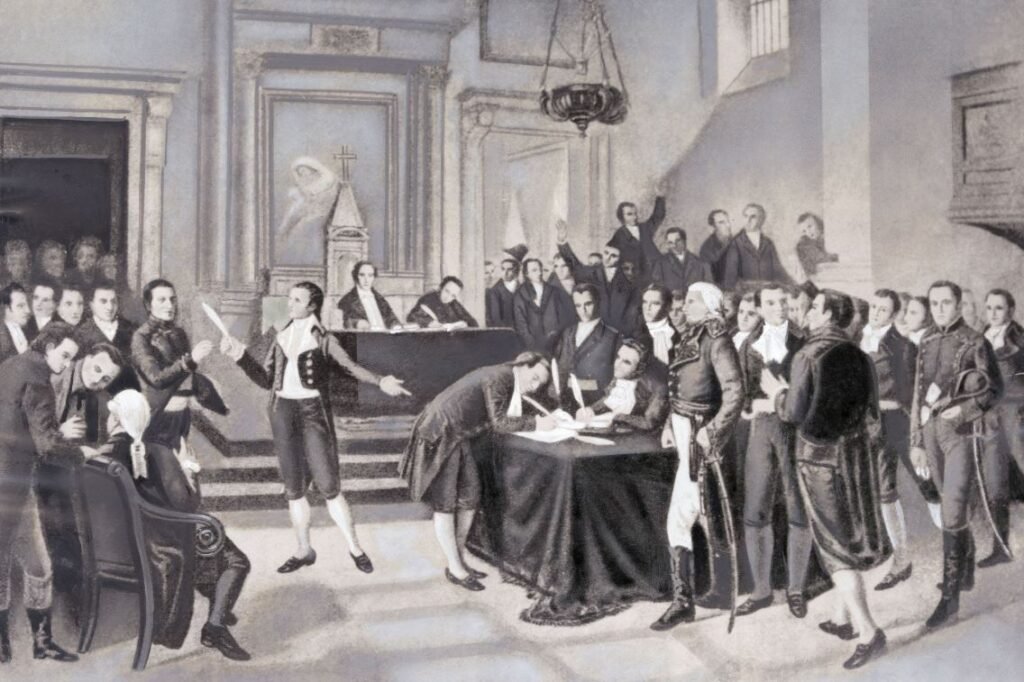
On July 5, 1811, the congress voted. The document, written primarily by Juan Germán Roscio and Francisco Isnardi, formally established the First Republic of Venezuela.
Venezuela was now, on paper at least, a free nation.
Revolutionary Ideas (With Some Convenient Exceptions)
The declaration and the constitution that followed in December 1811 were inspired by the big revolutionary movements of the era—the American Revolution and the French Revolution. The Venezuelan founders borrowed heavily from Enlightenment philosophy, which emphasized reason, individual rights, and the idea that governments should serve the people, not the other way around.
The new constitution rejected the old idea that kings ruled by God’s will. Instead, it established a republic where power came from the people and was divided among different branches of government to prevent any one person or group from becoming too powerful.
It all sounded very progressive and democratic.
But there was a catch—actually, several catches.
The criollo elite who wrote these documents wanted freedom for themselves, not necessarily for everyone else. They abolished noble titles (which they didn’t have anyway) and ended the slave trade (the buying and selling of new enslaved people). But they didn’t abolish slavery itself. The plantation economy depended on enslaved labor, and the landowners weren’t about to give that up.
They also made sure that only property owners could vote. In other words, the revolution was by the wealthy, for the wealthy.
The Dream Dies: One Year and Out
The triumph of independence lasted barely a year. By July 1812, the First Republic had completely collapsed. What went wrong?
Too Much Freedom, Too Fast: The 1811 Constitution gave enormous independence to each province. In theory, this sounds democratic. In practice, it was a disaster. When war came, the provinces couldn’t agree on anything. They couldn’t coordinate military strategy, couldn’t pool resources, and often worked at cross-purposes. Simón Bolívar would later bitterly criticize this extreme decentralization as one of the republic’s fatal flaws.
The Royalists Strike Back: Spanish military commanders, particularly Juan Domingo de Monteverde, organized a fierce counter-attack. But they didn’t do it alone—they had help from an unexpected source.
The People Weren’t on Board: Here’s the uncomfortable truth the criollo revolutionaries had to face: most of Venezuela’s population didn’t support them. The majority of people were pardos (mixed-race workers), Indigenous peoples, and enslaved Africans. To them, the criollo landowners weren’t liberators—they were oppressors.
The Spanish Crown cleverly positioned itself as the protector of common people against the wealthy rebels. Many poor Venezuelans actually fought for Spain against the republic. The revolution had become a class war, and the revolutionaries were on the wrong side of the numbers.
God’s Wrath (Or So They Said): On Holy Thursday, March 26, 1812, a massive earthquake struck Venezuela. It devastated cities controlled by the republicans, including Caracas, but largely spared areas held by royalist forces.
The Catholic clergy, who were overwhelmingly loyal to Spain, seized the moment. They preached from pulpits across the country that the earthquake was divine punishment for rebelling against the king. In a deeply religious society, this message was devastating to republican morale.
Legend has it that when panicked crowds filled the streets after the earthquake, Simón Bolívar stood on the rubble and shouted, “If Nature opposes us, we will fight against it and make it obey us!” It’s a great story, though historians debate whether it actually happened. Either way, it captures the desperate situation the republicans faced.
The End (And the Beginning)
By mid-1812, Francisco de Miranda was forced to sign a surrender agreement with the royalists. The First Republic was finished.
Simón Bolívar and other revolutionary leaders fled into exile, where they would regroup, rethink their strategy, and eventually launch new campaigns. The war for Venezuelan independence was far from over—in fact, it would drag on for another decade and spread across the entire continent.
But July 5, 1811, remained a pivotal moment. It proved that Spanish rule in the Americas could be challenged. It showed that colonial subjects could imagine themselves as citizens of their own nations. And it revealed the hard truth that declaring independence and actually achieving it were two very different things.
The First Republic failed, but it planted seeds that would eventually grow into the independent nations of South America. Sometimes the first attempt at something revolutionary isn’t meant to succeed—it’s meant