In the early afternoon of July 4, 1826, as church bells rang across America to celebrate the fiftieth anniversary of independence, John Adams lay dying in his bed in Quincy, Massachusetts. The ninety-year-old former president had been slipping in and out of consciousness for days.
Outside, the town was preparing for a grand jubilee—parades, speeches, cannon fire—to mark the half-century since the Declaration of Independence had been signed. Adams had been invited to attend the festivities, but his body had finally betrayed him. He could barely speak.
Around five o’clock in the afternoon, witnesses reported that Adams stirred. His lips moved. Those gathered around his deathbed leaned in close to catch his final words. What they heard was a whisper, barely audible: “Thomas Jefferson survives.”
Then he was gone.
It was a beautiful sentiment—a dying man’s thoughts turning to his old friend and rival, the co-architect of American independence. Adams seemed to take comfort in the idea that Jefferson, at least, would live on to see this golden anniversary, to witness what their revolution had become.
But Adams was wrong.
Five hundred miles to the south, at Monticello in Virginia, Thomas Jefferson had died that same morning around ten o’clock. He was eighty-three years old. He had held on just long enough—asking his doctor repeatedly in his final days, “Is it the Fourth?”—to die on the anniversary of the document that had made him immortal.
Neither man knew that the other was dying. Neither could have orchestrated this final symmetry. And yet there it was: the two principal authors of American independence, dying on the same day, exactly fifty years after they had pledged their lives, their fortunes, and their sacred honor to the cause of liberty. It was as if history itself had decided that their lives were so fundamentally intertwined that they could not be separated, even in death.
The news spread slowly across the young nation. When people learned that both Adams and Jefferson had died on July 4, 1826, many saw it as a sign—divine providence, perhaps, or the hand of fate confirming that these two men belonged together in the American story. Their deaths became instant legend, a coincidence so perfect it seemed scripted by the gods.
But the real story—the one that makes this coincidence so haunting—is not just that they died together. It’s that they had lived together, fought together, hated each other, and finally, in their twilight years, loved each other again. Their fifty-year arc traced the entire emotional geography of the American experiment itself.
The Dynamic Duo of 1776
They could not have been more different.
John Adams was short, stout, and perpetually agitated. He had the build of a New England farmer and the temperament of a trial lawyer who’d had too much coffee. Born in Braintree, Massachusetts, to a modest family, Adams had clawed his way up through sheer intellectual force and an almost pathological work ethic. He was brilliant, prickly, vain, and brutally honest—the kind of man who would tell you exactly what he thought of you and then be hurt when you didn’t thank him for it. He talked too much. He knew he talked too much. He couldn’t help himself.
Thomas Jefferson was tall, elegant, and maddeningly reserved. He moved through the world with the quiet confidence of Virginia aristocracy, a man born into wealth and slaves, educated in the classics, fluent in five languages, accomplished in architecture, music, and natural philosophy. Where Adams blustered, Jefferson glided. Where Adams confronted, Jefferson deflected. Jefferson hated conflict, hated public speaking, hated the rough-and-tumble of political debate. He preferred to work behind the scenes, writing letters, drafting documents, letting others do the shouting.
In the summer of 1776, these two men found themselves thrown together in Philadelphia as delegates to the Continental Congress. The colonies were on the brink of revolution, and someone needed to articulate why. The Congress appointed a committee of five to draft a declaration of independence: Jefferson, Adams, Benjamin Franklin, Roger Sherman, and Robert Livingston.
The committee met and quickly decided that one person should write the first draft. Adams later recalled the conversation he had with Jefferson about who that person should be.
Jefferson, Adams said, had insisted that Adams should write it.
“I will not,” Adams replied.
“You should do it,” Jefferson pressed.
“Oh no!”
“Why will you not? You ought to do it.”
“I will not.”
“Why?”
Adams then laid out his reasoning with characteristic bluntness: “Reason first: you are a Virginian, and a Virginian ought to appear at the head of this business. Reason second: I am obnoxious, suspected, and unpopular. You are very much otherwise. Reason third: you can write ten times better than I can.”
It was true. Adams knew his strengths and his weaknesses. He was the voice of independence—the man who had spent months on the floor of Congress arguing, cajoling, and bullying reluctant delegates toward the inevitable break with Britain. He had earned the nickname “Atlas of Independence” because he seemed to carry the entire weight of the revolution on his shoulders. But he was not a poet. He was not a philosopher. He was a lawyer and a fighter.
Jefferson, on the other hand, had barely spoken in Congress. But when he put pen to paper, something magical happened. His words had a lyrical quality, a rhythm and elegance that could transform political argument into something approaching scripture.
So Jefferson wrote, and Adams defended.
For seventeen days in June 1776, Jefferson sat in his rented rooms on Market Street, scratching out draft after draft of the Declaration. He borrowed liberally from his own previous writings, from George Mason’s Virginia Declaration of Rights, from John Locke’s theories of natural rights. But the voice was distinctly his own: “We hold these truths to be self-evident, that all men are created equal, that they are endowed by their Creator with certain unalienable Rights, that among these are Life, Liberty and the pursuit of Happiness.”
When Jefferson presented his draft to the committee, Adams read it and knew immediately that it was perfect. When Congress began debating the Declaration on July 1, it was Adams who rose again and again to defend Jefferson’s words against those who wanted to water them down or strike out controversial passages. Jefferson sat silently, wincing every time Congress made a change, while Adams fought for every sentence.
Years later, Jefferson would write that Adams was “the pillar of [the Declaration’s] support on the floor of Congress, its ablest advocate and defender against the multifarious assaults it encountered.”
On July 4, 1776, Congress approved the Declaration. Fifty-six men signed it, knowing that they were committing treason against the British Crown, that if the revolution failed they would all hang. Adams and Jefferson signed side by side.
In that moment, they were partners in the truest sense—two halves of a whole, the voice and the pen, the fighter and the philosopher. They had created something together that neither could have created alone. They had articulated the founding principles of a new nation, and in doing so, they had bound their lives together forever.
They had no idea how complicated that bond would become.
The Forgotten Intimacy in Europe
If you want to understand the tragedy of what came later—the bitterness, the betrayal, the decade of silence—you have to understand how close they were first. You have to understand what they meant to each other in those years after the revolution, when they were not yet enemies, when they were simply friends.
The war ended in 1783. America had won its independence, but the new nation was fragile, broke, and desperate for international recognition. Congress needed diplomats in Europe to negotiate treaties and secure loans. In 1784, they sent Jefferson to Paris to join Adams, who was already there, and Benjamin Franklin. The following year, Adams was appointed minister to Great Britain and moved to London, while Jefferson remained in Paris as minister to France.
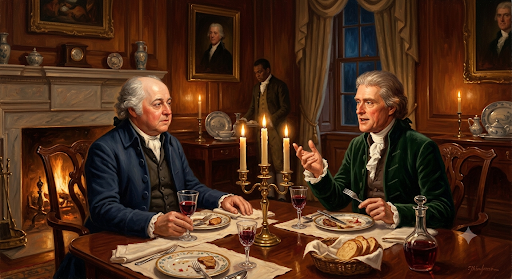
For the next four years, Adams and Jefferson lived across the English Channel from each other, and they visited constantly. Jefferson would cross to London; Adams would cross to Paris. They traveled together through the English countryside, touring gardens and examining architecture. They went to plays and concerts. They argued about philosophy and politics and books. They became, in the fullest sense of the word, intimate friends.
Their families became intertwined. Abigail Adams, John’s brilliant and formidable wife, adored Jefferson. When Jefferson first arrived in Paris in 1784, still grieving the death of his wife Martha two years earlier, it was Abigail who took him under her wing. She worried about him. She scolded him for not writing often enough. She treated him like a beloved younger brother, which, in a way, he was—Jefferson was fourteen years younger than John Adams.
Jefferson’s daughter Patsy lived with the Adamses in London for a time, and Abigail doted on her. When Jefferson’s younger daughter Polly arrived in Europe in 1787, it was Abigail who received her in London and cared for her before sending her on to Paris. The two families spent holidays together, shared meals, exchanged gifts and letters.
But the friendship between John and Thomas went deeper than social pleasantries. They were intellectual soulmates. Both men were voracious readers, obsessed with history and political philosophy. They would spend hours debating the merits of different forms of government, dissecting the rise and fall of ancient republics, arguing about human nature and the prospects for democracy. Adams was more pessimistic, more convinced of humanity’s capacity for corruption and tyranny. Jefferson was more optimistic, more trusting in the wisdom of ordinary people. But they loved the argument itself, the clash of ideas, the way a good debate could sharpen your thinking.
Jefferson later wrote that Adams had “a sound head on substantial points, and I think he has integrity.” This was high praise from Jefferson, who was sparing with compliments. Adams, for his part, wrote to a friend that Jefferson was “an old friend with whom I have often had occasion to labor at many a knotty problem, and in whose abilities and steadiness I always found great cause to confide.”
There was genuine affection between them. When Adams left Paris to take up his post in London, Jefferson wrote to him: “The departure of your family has left me in the dumps. My afternoons hang heavily on me.” He missed Adams. He missed the conversations, the companionship, the sense of having someone who understood what they had been through together during the revolution.
In 1786, the two men took a trip together through the English countryside, ostensibly to examine English gardens but really just to spend time together. They visited Shakespeare’s birthplace in Stratford-upon-Avon. They toured the gardens at Stowe and Blenheim Palace, taking notes on landscape design. They argued about whether English gardens were superior to French ones (Adams thought they were; Jefferson disagreed). It was a kind of idyll—two middle-aged revolutionaries playing tourist, enjoying each other’s company, secure in their friendship.
Jefferson kept a detailed journal of the trip. At one point, he noted that they had visited the site where King Richard III was killed at the Battle of Bosworth Field. Standing on that historic ground, the two Americans must have reflected on the irony: here they were, representatives of a republic that had overthrown a king, walking through the landscape of English monarchy, tourists in the country they had rebelled against.
But the trip was more than just sightseeing. It was a deepening of their bond. They were not just colleagues or fellow diplomats. They were friends in the truest sense—men who enjoyed each other’s company, who challenged each other intellectually, who trusted each other completely.
When Adams returned to America in 1788, and Jefferson followed a year later, they carried that friendship home with them. They had been through the revolution together. They had helped create a new nation together. They had lived abroad together, representing America to the world. They were bound by shared experience, shared ideals, shared sacrifice.
In 1789, when George Washington became the first president of the United States, he appointed Adams as vice president and Jefferson as secretary of state. The two friends would serve together in the new government, helping to build the republic they had imagined.
It should have been the beginning of a beautiful partnership.
Instead, it was the beginning of the end.
They could not have imagined that within a decade, this friendship would become one of the nation’s greatest casualties.
The Great Ideological Rift
The problem was that they disagreed about everything that mattered.
Not the big things—they both believed in republican government, in liberty, in the revolutionary principles they had fought for. But when it came to the practical questions of how to actually run a country, how to structure a government, how to balance freedom and order, they were on opposite sides of a chasm that kept getting wider.
It started with Alexander Hamilton.
Hamilton, Washington’s brilliant and ambitious secretary of the treasury, had a vision for America’s future: a strong central government, a national bank, federal assumption of state debts, encouragement of manufacturing and commerce, close ties with Britain. It was a vision of America as a modern, industrial, commercial power—a nation that could compete with the great powers of Europe on their own terms.
Adams looked at Hamilton’s vision and saw wisdom. Yes, Hamilton was arrogant and overreaching, but he understood something essential: human beings were not angels. They were greedy, ambitious, prone to faction and violence. You couldn’t just trust people to govern themselves without strong institutions to check their worst impulses. You needed a powerful central government to maintain order, to prevent chaos, to keep the fragile republic from tearing itself apart.
Adams had spent years studying the history of republics, and he knew how they died. They died from too much democracy, from mob rule, from demagogues who whipped up popular passion and destroyed institutions. The French Revolution, which had begun in 1789 with such hope, had descended into terror and bloodshed by 1793. Adams watched the guillotines fall in Paris and thought: This is what happens when you trust the people too much. This is what happens when you tear down all authority and let passion rule.
Jefferson looked at Hamilton’s vision and saw tyranny.
A national bank? That was unconstitutional, an overreach of federal power. Federal assumption of state debts? That was a scheme to enrich northern speculators at the expense of southern farmers. Encouragement of manufacturing? That would create a class of urban workers dependent on wages, corrupted by luxury, divorced from the land. Close ties with Britain? That was betraying the revolution, cozying up to the very monarchy they had fought to escape.
Jefferson’s vision of America was radically different. He imagined a nation of independent farmers, each man owning his own land, beholden to no one, governing himself. The central government should be as weak as possible, leaving most power to the states and to local communities. America should be agrarian, not industrial—a pastoral republic where virtue was cultivated in the soil, where men were free because they were self-sufficient.
And the French Revolution? Jefferson saw it as the continuation of the American Revolution, the spread of liberty across the Atlantic. Yes, there was violence, but that was the price of overthrowing tyranny. “The tree of liberty must be refreshed from time to time with the blood of patriots and tyrants,” Jefferson wrote in 1787. He meant it.
These were not minor disagreements. They were fundamentally different philosophies of what America should be, rooted in fundamentally different views of human nature.
Adams believed that people were naturally hierarchical, that inequality was inevitable, that the best you could do was create institutions strong enough to channel human ambition and greed into productive ends. He believed in checks and balances, in a strong executive, in the rule of law enforced by a powerful government.
Jefferson believed that people were naturally good, that inequality was artificial, that the best you could do was get government out of the way and let people govern themselves. He believed in minimal government, in states’ rights, in the wisdom of ordinary farmers uncorrupted by the vices of cities and courts.
In the 1790s, these competing visions crystallized into America’s first political parties. Hamilton and Adams became the leaders of the Federalist Party. Jefferson and his ally James Madison became the leaders of the Democratic-Republican Party. And suddenly, the friendship between Adams and Jefferson was caught in the crossfire.
It started with policy disputes. Jefferson, as secretary of state, clashed constantly with Hamilton over foreign policy. When Britain and France went to war in 1793, Hamilton wanted to side with Britain; Jefferson wanted to side with France. Washington tried to steer a neutral course, but the cabinet was bitterly divided.
Then it became personal. Federalist newspapers began attacking Jefferson as a dangerous radical, an atheist, a Jacobin who wanted to bring French-style terror to America. Republican newspapers attacked Adams as a monarchist, a would-be tyrant who wanted to crown himself king.
Neither man was directly responsible for these attacks—they didn’t write the articles themselves—but they didn’t stop them either. And slowly, the poison seeped into their friendship.
In 1796, Washington declined to run for a third term, and Adams and Jefferson both ran for president. Under the system at the time, whoever came in second would become vice president. Adams won narrowly, and Jefferson became his vice president.
It was an awkward arrangement. Adams was a Federalist; Jefferson was a Republican. They were supposed to work together, but they were leading opposing parties. Cabinet meetings became tense. Jefferson began to see Adams not as his old friend but as the leader of a party that was betraying the revolution. Adams began to see Jefferson not as his old friend but as the leader of a party that was trying to destroy the government.
The breaking point came with the Alien and Sedition Acts of 1798.
France and America were on the brink of war. French ships were seizing American vessels. There was talk of a French invasion. Adams and the Federalists were terrified that French agents and sympathizers in America would undermine the government from within. So they passed a series of laws: the Alien Acts, which gave the president power to deport foreigners deemed dangerous, and the Sedition Act, which made it a crime to publish “false, scandalous, and malicious writing” against the government.
To Jefferson, this was tyranny. The Sedition Act was a direct assault on the First Amendment, a tool to silence Republican newspapers and crush political opposition. It was exactly the kind of authoritarian overreach he had always feared from a strong central government.
He fought back. Secretly, Jefferson drafted the Kentucky Resolutions, which argued that states had the right to nullify unconstitutional federal laws. Madison drafted similar resolutions for Virginia. It was a radical argument—one that would echo through American history, eventually contributing to the Civil War—but Jefferson believed it was necessary to preserve liberty.
Adams, for his part, defended the Alien and Sedition Acts as necessary wartime measures. He saw Jefferson’s opposition as proof that the Republicans were more loyal to France than to America, that they were willing to undermine the government in a time of crisis.
The friendship was dying. They still saw each other—they had to, since Jefferson was vice president—but the warmth was gone. The easy conversations, the intellectual sparring, the affection—all of it had curdled into suspicion and resentment.
By 1800, they were no longer friends. They were enemies.
The Bitter Rupture of 1800
The election of 1800 was one of the ugliest in American history.
Adams was running for reelection as a Federalist. Jefferson was challenging him as a Republican. And both sides unleashed a torrent of slander and vitriol that makes modern political campaigns look tame by comparison.
Federalist newspapers called Jefferson an atheist, a coward, a slaveholder who had fathered children with his slaves (this last charge, though denied at the time, would later be proven largely true). They said that if Jefferson won, the nation would descend into chaos and bloodshed. Churches would be burned. The Bible would be confiscated. Women would be ravished in the streets.
Republican newspapers called Adams a monarchist, a warmonger, a tyrant who wanted to crown himself king and marry one of his sons to a daughter of King George III to reunite America with Britain. They mocked his weight, his vanity, his temper. They said he was senile, corrupt, a hermaphrodite (yes, really—that was an actual insult printed in a Republican newspaper).
Neither Adams nor Jefferson wrote these attacks themselves, but both men knew about them, and neither did much to stop them. The campaign was being run by their supporters, by party operatives who believed that the fate of the republic hung in the balance. And maybe it did. Both sides genuinely believed that if the other side won, America would be destroyed.
For Adams, the campaign was agony. He was already deeply unpopular within his own party. Hamilton, who despised him, had written a pamphlet attacking his character and judgment. His own cabinet had been undermining him, taking orders from Hamilton instead of from the president. Adams felt betrayed on all sides.
And now his old friend—the man he had worked with to create the Declaration of Independence, the man he had traveled with through England, the man whose family had been like family to him—was running against him, trying to take away the presidency.
Adams took it personally. How could he not? This wasn’t just a political disagreement anymore. This was a repudiation of everything he had done, everything he believed in. Jefferson was saying that Adams’s vision of America was wrong, that his presidency had been a failure, that he was unfit to lead.
Jefferson, for his part, believed he was saving the republic. He saw Adams as a good man who had been corrupted by power, who had betrayed the principles of the revolution. The Alien and Sedition Acts were proof of that. Adams had become what they had fought against—a tyrant who used the law to silence his critics.
The election was close. When the votes were counted, Jefferson had won. But there was a complication: Jefferson and his running mate, Aaron Burr, had tied in the Electoral College. Under the Constitution, that meant the House of Representatives would decide the winner. It took thirty-six ballots over six days before Jefferson was finally declared president.
Adams was humiliated. He had lost to his former friend. His party had turned on him. His presidency, which he had hoped would be a capstone to his career, was being judged a failure.
On March 4, 1801, the day of Jefferson’s inauguration, Adams was not there. He had left Washington before dawn, riding out of the capital in a public stagecoach, refusing to witness his successor’s triumph. It was a bitter, petty gesture—a final act of defiance and hurt.
Jefferson took the oath of office without Adams present. In his inaugural address, he tried to strike a conciliatory tone: “We are all Republicans, we are all Federalists,” he said, calling for unity. But the words rang hollow. Adams was gone. The friendship was over.
For the next eleven years, Adams and Jefferson did not speak. They did not write. They were two old men, living out their retirement in Massachusetts and Virginia, nursing their wounds, convinced that the other had betrayed everything they had once stood for together.
The silence was deafening.
The Sunset Correspondence
The reconciliation began with a nudge from a mutual friend.
Benjamin Rush, a Philadelphia physician who had signed the Declaration of Independence alongside Adams and Jefferson, had stayed close to both men over the years. He was troubled by their estrangement. These were two of the greatest minds of the revolutionary generation, two men who had given everything to create America, and they were spending their final years in bitter silence. It seemed like a tragedy—not just for them, but for the nation.
In 1809, Rush began writing to both men, gently suggesting that they should reconcile. He told Adams that Jefferson still spoke warmly of him. He told Jefferson that Adams bore him no ill will. He exaggerated a bit, smoothing over the rough edges, playing the role of peacemaker.
It took three years, but finally, on January 1, 1812, Adams broke the silence.
He sent Jefferson a short letter, along with a gift: “two pieces of Homespun,” which turned out to be two volumes of lectures on rhetoric by John Quincy Adams, John’s son. The letter was brief, almost casual, as if they were old friends who had simply lost touch for a while. “I send you two Pieces of Homespun lately produced in this quarter by One who was honoured in his youth with some of your Attention and much of your kindness.”
Jefferson wrote back immediately. His reply was warm, relieved, almost giddy. “A letter from you calls up recollections very dear to my mind. It carries me back to the times when, beset with difficulties and dangers, we were fellow laborers in the same cause, struggling for what is most valuable to man, his right of self-government.”
And just like that, the dam broke.
Over the next fourteen years, until their deaths in 1826, Adams and Jefferson exchanged 158 letters. They wrote about everything: philosophy, religion, politics, history, science, agriculture, their families, their health, their memories. The letters were long, rambling, digressive—the kind of letters you write when you have time and when you’re writing to someone who understands you.
They were old men now, in their seventies and eighties, and they knew they didn’t have much time left. There was an urgency to the correspondence, a sense that they needed to say everything they had left to say before it was too late.
They argued, of course. They couldn’t help themselves. Adams would make some claim about human nature or the nature of government, and Jefferson would push back, and they would be off, debating like they had in the old days. But the bitterness was gone. They were arguing for the joy of it now, for the intellectual stimulation, not to wound each other.
One of their favorite topics was religion. Adams was a Unitarian, skeptical of orthodox Christianity but convinced of the existence of God and the immortality of the soul. Jefferson was even more heterodox—he had literally cut up a Bible with a razor, removing all the supernatural elements and keeping only Jesus’s moral teachings. He believed Jesus was a great moral philosopher but not divine.
In 1813, Adams wrote to Jefferson: “I have been a Church going Animal for Seventy Six Years… I have read the Bible through many times… I have made it a rule for more than fifty years to read the Bible through once a year… I have been alternately delighted and disgusted with the Bible.”
Jefferson replied: “I too have made a wee little book, from the same materials, which I call the Philosophy of Jesus. It is a paradigma of his doctrines, made by cutting the texts out of the book, and arranging them on the pages of a blank book, in a certain order of time or subject. A more beautiful or precious morsel of ethics I have never seen.”
They were both heretics by the standards of their day, and they knew it. But they could be honest with each other in a way they couldn’t be with most people. They could admit their doubts, their questions, their unorthodox beliefs, without fear of judgment.
They also wrote about aging and death. Both men were acutely aware that they were living on borrowed time. Adams, in particular, was obsessed with mortality. He wrote to Jefferson in 1816: “I am sometimes afraid that my ‘Machine’ will not ‘Surcease Motion’ soon enough; for I dread nothing so much as ‘dying at top’ and expiring like Dean Swift ‘a Driveller and a Show.'”
Jefferson, always more stoic, replied: “There is a ripeness of time for death, regarding others as well as ourselves, when it is reasonable we should drop off, and make room for another growth. When we have lived our generation out, we should not wish to encroach on another.”
They were preparing themselves, and each other, for the end.
But the most poignant theme in their letters was their shared uncertainty about whether their revolution would survive. They had created something unprecedented—a republic based on the consent of the governed, on the idea that ordinary people could govern themselves. But would it last? Or would America go the way of ancient Rome, descending into tyranny or chaos?
Adams was pessimistic. He had always been pessimistic. He wrote to Jefferson in 1815: “Democracy has never been and never can be so durable as Aristocracy or Monarchy. But while it lasts it is more bloody than either… Remember, Democracy never lasts long. It soon wastes exhausts and murders itself. There never was a Democracy Yet, that did not commit suicide.”
Jefferson pushed back, but gently. He still believed in the people, in their capacity for self-government. But he admitted that the experiment was fragile. In 1823, he wrote: “The generation which commences a revolution rarely completes it… I shall not die without a hope that light and liberty are on steady advance.”
They were both right, in a way. The American experiment would survive, but it would be tested again and again—by civil war, by economic collapse, by foreign threats, by internal divisions. Adams and Jefferson wouldn’t live to see most of those tests. But they had done their part. They had created the foundation. The rest was up to future generations.
As the years passed, the letters became more reflective, more philosophical. They were no longer arguing about policy or politics. They were trying to make sense of their lives, to understand what it had all meant.
In 1823, Adams wrote to Jefferson: “You and I ought not to die before We have explained ourselves to each other.”
And that’s what they were doing, in these letters. They were explaining themselves. They were saying: This is who I am. This is what I believe. This is why I did what I did. And they were listening to each other, really listening, in a way they hadn’t been able to do when they were younger and the stakes felt so high.
They discovered something important: they had never really disagreed about the big things. They both loved the republic. They both believed in liberty. They both wanted America to succeed. They had disagreed about the machinery—about how much power the government should have, about how to balance freedom and order—but they had agreed about the purpose.
Jefferson put it best in a letter from 1813: “The same political parties which now agitate the U.S. have existed thro’ all time… the sickly, weakly, timid man, fears the people, and is a tory by nature. The healthy, strong and bold, cherishes them, and is formed a whig by nature.”
Adams read that and laughed. He wrote back: “Who are the ἄριστοι [aristoi, the best]? … Talents, Virtues and Wealth, may be the Aristocracy… But what are Talents, Virtues and Wealth? Talents? Genius? or Cunning? Virtues? or Hypocrisy? Wealth? or Tricks?”
They were still arguing. But now they were arguing as friends, as equals, as two old men who had been through too much together to let politics come between them anymore.
In their final letters, there was a tenderness that hadn’t been there before. In 1825, Adams wrote to Jefferson: “I am sometimes afraid that my ‘Machine’ will not ‘Surcease Motion’ soon enough… But I am not weary of Life. I have a great deal to do yet.”
Jefferson replied: “I am tired of hearing about the ‘good old times.’ I prefer the present, with all its difficulties.”
They were saying goodbye, though neither would admit it. They were thanking each other, though they couldn’t quite find the words. They were acknowledging that their lives had been bound together, that they had needed each other—not just in 1776, but always.
The last letter Jefferson wrote to Adams was dated March 25, 1826. He was too weak to write much. His hand shook. But he managed a few lines, thanking Adams for a book he had sent, wishing him well.
Adams’s last letter to Jefferson was dated April 17, 1826. He was also failing. His eyesight was going. His hands trembled. But he wrote: “I am certainly very near the end of my life… I am not afraid of death, but I dread the pain.”
Neither man wrote again. They were both too ill.
But they had said what they needed to say.
The Final Symmetry and Meaning
On the morning of July 4, 1826, Thomas Jefferson woke at Monticello knowing he was dying. He had been drifting in and out of consciousness for days. His doctor was with him. His family surrounded his bed.
At some point—the exact time is disputed—Jefferson asked: “Is it the Fourth?”
“It soon will be,” someone replied.
Jefferson nodded. He had held on long enough. He died around ten o’clock in the morning.
Five hundred miles to the north, John Adams was also dying. He had been bedridden for days, barely able to speak. The town of Quincy was celebrating the Fourth with parades and speeches, but Adams was too weak to participate. He lay in his bed, listening to the distant sound of church bells and cannon fire.
Around five o’clock in the afternoon, Adams stirred. His lips moved. Those gathered around him leaned in close.
“Thomas Jefferson survives,” Adams whispered.
Then he died.
When the news spread that both men had died on July 4, 1826—exactly fifty years after the Declaration of Independence—the nation was stunned. It seemed impossible, too perfect to be coincidence. Newspapers called it “visible and palpable” proof of divine favor. Preachers delivered sermons about the hand of Providence. Poets wrote odes to the symmetry of it all.
Daniel Webster, the great orator, captured the mood in a eulogy: “It cannot be denied, but it is wonderful. A strange and striking coincidence… that these two should live to see the fiftieth year from the date of that act; that they should complete that year; and that then, on the day which had fast linked forever their own fame with their country’s glory, the heavens should open to receive them both at once.”
But the real miracle wasn’t just that they died on the same day. The real miracle was the arc of their lives—the journey they had taken together.
They had started as partners, two men from different worlds who found common cause in revolution. They had created something together that neither could have created alone: a declaration of principles that would echo through history, inspiring revolutions and liberation movements for centuries to come.
Then they had become enemies, torn apart by competing visions of what America should be. They had spent a decade in bitter silence, each convinced that the other had betrayed the revolution they had fought for together.
And finally, in their twilight years, they had become friends again—not by compromising their principles, but by transcending them, by recognizing that their shared love of the republic was deeper than their disagreements about how to run it.
That arc—partnership, rupture, reconciliation—is the arc of democracy itself.
Democracy is not about agreement. It’s about disagreement. It’s about people with fundamentally different visions of the good life finding a way to live together, to argue without killing each other, to compete for power without destroying the system that makes competition possible.
Adams and Jefferson understood this, eventually. They had to learn it the hard way, through years of bitterness and estrangement. But they learned it.
Their reconciliation suggests something profound: that principle and friendship are not incompatible, that you can disagree with someone about everything that matters and still respect them, still love them, still recognize that you need them.
Adams needed Jefferson. He needed Jefferson’s optimism, his faith in the people, his vision of a freer, more egalitarian society. Without Jefferson, Adams’s pessimism would have curdled into cynicism, his realism into authoritarianism.
Jefferson needed Adams. He needed Adams’s skepticism, his understanding of human weakness, his insistence that institutions matter. Without Adams, Jefferson’s optimism would have been naive, his faith in the people dangerously utopian.
Together, they represented the two poles of the American experiment: order and liberty, realism and idealism, caution and hope. The tension between those poles is what makes democracy work. You need both. You need the Adams voice saying, “Be careful, people are flawed, institutions matter.” And you need the Jefferson voice saying, “Trust the people, take risks, expand freedom.”
The fact that they died on the same day—on the fiftieth anniversary of the Declaration—seemed to confirm what their lives had already proven: that they belonged together, that their fates were intertwined, that you couldn’t tell the story of one without telling the story of the other.
Adams’s last words—”Thomas Jefferson survives”—were wrong in the literal sense. Jefferson had already died. But in a deeper sense, Adams was right. Jefferson did survive. They both survived. Their ideas, their arguments, their competing visions of America—all of it survived, woven into the fabric of the nation they had created.
Two hundred years later, we’re still arguing about the same things Adams and Jefferson argued about. We’re still debating how much power the government should have, how to balance freedom and order, whether to trust the people or fear them. We’re still trying to figure out what kind of country America should be.
And that’s exactly as it should be. Because the American experiment was never meant to be finished. It was meant to be ongoing, a perpetual argument, a constant negotiation between competing visions of the good.
Adams and Jefferson gave us the terms of that argument. They showed us that it’s possible to disagree fiercely and still remain united, to fight over principles and still love the republic, to be enemies and then friends and then, in the end, something more than either—partners in a project larger than themselves.
On July 4, 1826, as the nation celebrated fifty years of independence, two old men died within hours of each other. They had lived through revolution and war, through the creation of a new nation, through bitter political battles and personal estrangement. They had hated each other and loved each other. They had built something together, torn it apart, and then, in their final years, found their way back to each other.
Their deaths on the same day seemed to say: This is what we were. This is what we did. We were bound together, always, even when we didn’t know it, even when we couldn’t stand each other. We were two halves of a whole, and you need both halves to understand what we created.
The American experiment continues. The argument continues. And somewhere in that argument, if you listen closely, you can still hear the voices of Adams and Jefferson, still debating, still disagreeing, still trying to explain themselves to each other.
Still surviving.