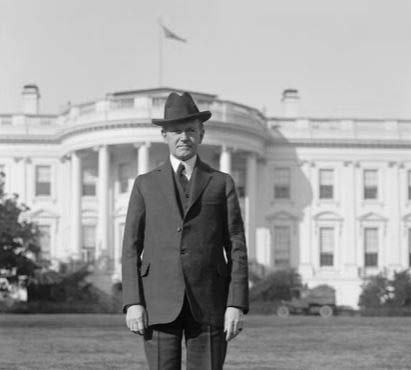
Calvin Coolidge became the nation’s 30th president in 1923 upon the death of Warren G. Harding. He served until 1929, having been elected once on his own but refusing to run again in 1928. He was known as Silent Cal, though that is not an entirely accurate description.
Coolidge mastered the use of the radio to bring his message to the American public, and his message was one of laissez-faire capitalism. Ronald Reagan, our 40th chief executive, loved Silent Cal, who set the stage for Reagan’s tax cuts with his own round of right-sizing both the federal budget and the nation’s tax burden.
Unfortunately, Coolidge has been blamed for the Great Depression, which ensued seven months after he left office. Those accusing him of causing it cite his refusal to regulate Wall Street. The causes, of course, run deeper than that. There was also a depression in 1920 equally as drastic as the Great One, but no one interfered with interest rates and social programs, and the economic turmoil subsided quickly through natural forces.
My point: After being lambasted daily by Donald Trump’s incessant banter — most of it just made-up “facts” to suit his domestic and international programs — we could use another “Silent” Cal. Wouldn’t it be nice to turn on the news and not hear endless bombardments from our president, many of them mean-spirited? We could use a Silent Cal modern version in the White House come 2029 — or earlier!
Here’s an AI-generated overview of the Coolidge time in the White House:
The presidency of Calvin Coolidge (1923–1929) represents the high-water mark of American roaring-twenties conservatism. Stepping into office after the sudden death of Warren G. Harding, Coolidge brought a stark change in style and ethics to a White House that had been rocked by scandals like Teapot Dome. His philosophy was simple: minimal government intervention, fiscal restraint, and a deep belief that “the chief business of the American people is business.”
Why Was He Called “Silent Cal”?
The nickname “Silent Cal” came from his famously laconic, deadpan personality. In an era where politicians were known for booming, theatrical speeches, Coolidge was remarkably quiet in private conversation. He viewed words as something to be used efficiently, not wasted.
His silence became a legendary part of his public persona, inspiring countless anecdotes. The most famous story — which may be apocryphal but perfectly captures his reputation — involves a dinner party guest who sat next to him and said:
“Mr. President, I made a bet with a friend that I could get more than two words out of you tonight.”
Coolidge looked at her and calmly replied: “You lose.”
Despite his private quietness, he was actually highly effective at public communication. He held regular, open press conferences and was the first president to master the new medium of radio, using it to deliver monthly addresses directly to the American public.
Major Accomplishments and Policies
Coolidge’s presidency was defined by the economic boom of the 1920s. His administration focused heavily on paying down national debt and cutting taxes, believing that leaving money in the pockets of citizens and corporations would fuel prosperity.
- Fiscal Discipline and Tax Cuts
Working closely with his wealthy Treasury Secretary, Andrew Mellon, Coolidge slashed federal taxes. The Revenue Acts of 1924, 1926, and 1928 drastically lowered individual income tax rates (bringing the top bracket down from 65% to 25%) and eliminated taxes for lower-income Americans entirely. At the same time, he rigidly cut federal spending, managing to retire one-fourth of the total national debt.
- The Indian Citizenship Act (1924)
One of the most significant social milestones of his presidency was signing the Indian Citizenship Act of 1924 (also known as the Snyder Act). This granted full U.S. citizenship to all Native Americans born within the United States, many of whom had previously been excluded from citizenship rights despite serving in World War I.
- The Kellogg-Briand Pact (1928)
In foreign policy, Coolidge’s administration sought to promote global peace without entering binding military alliances. The highlight of this strategy was the Kellogg-Briand Pact, an international agreement signed by the U.S., France, Germany, and eventually over 60 other nations, which outlawed war as an instrument of national policy. While it lacked enforcement mechanisms, it was a major diplomatic milestone of the interwar era.
- Immigration Restriction
Coolidge signed the Immigration Act of 1924 (The Johnson-Reed Act), which established a strict national-origins quota system. It severely limited immigration from Southern and Eastern Europe and banned immigration from Asia entirely. Reflecting the isolationist sentiment of the era, Coolidge remarked at the time that “America must be kept American.”
The Economy of the Coolidge Era
The “Coolidge Prosperity” saw a massive surge in manufacturing, consumer spending, and the widespread adoption of the automobile and electrical appliances.
| Economic Indicator | Trend Under Coolidge |
| Federal Debt | Reduced from ~$22.3 billion to ~$16.9 billion |
| Unemployment | Remained remarkably low, averaging roughly 3% |
| Federal Budget | Maintained a consistent surplus every single year |
The Blind Spot: While the industrial urban economy soared, the agricultural sector suffered a severe depression throughout the 1920s due to overproduction and falling prices. Coolidge twice vetoed the McNary-Haugen Farm Relief Bill, arguing that government price-fixing for crops was an unconstitutional and dangerous intervention in the free market.
Historical Legacy
Coolidge left office in March 1929 at the height of his popularity, famously choosing not to run for re-election in 1928 with a simple, characteristically brief note to reporters: “I do not choose to run for President in 1928.”
Months later, the stock market crashed, triggering the Great Depression. Historians continue to debate his legacy: supporters praise his unyielding fiscal responsibility, integrity, and respect for constitutional limits, while critics argue that his hands-off, laissez-faire regulatory approach allowed the financial speculation of the 1920s to spiral out of control.
How did Calvin Coolidge’s economic policies and laissez-faire approach impact the onset of the Great Depression?
The link between Calvin Coolidge’s economic policies and the Great Depression is one of the most fiercely debated topics in American economic history.
Because the stock market crashed in October 1929—just seven months after Coolidge left office—historians and economists have spent a century untangling how much of the disaster was caused by his hands-off, laissez-faire (let-it-be) approach, versus how much belonged to global factors or the mistakes of his successor, Herbert Hoover.
- The Argument That Coolidge’s Policies Fueled the Crash
Critics argue that Coolidge’s ultra-minimalist approach to government created an unstable economic bubble. By the time he left office, several structural weaknesses had locked into place:
- Undermining the Federal Reserve: Coolidge and his Treasury Secretary, Andrew Mellon, favored cheap credit to keep the 1920s boom going. When the Federal Reserve grew concerned about wild stock market speculation in 1927 and wanted to raise interest rates to cool things down, the administration publicly pressured them to keep rates low. This easy-money policy pumped continuous fuel into the speculative fire.
- A “Hands-Off” Regulatory Blindness: The 1920s saw the massive rise of investment trusts and buying stocks “on margin” (borrowing up to 90% of the money to buy a stock). Coolidge believed the federal government had no business policing Wall Street. This lack of oversight allowed highly leveraged, fragile financial structures to multiply unchecked.
- The Agribusiness Collapse: While cities boomed, American farmers were in a deep depression throughout the 1920s due to plummeting crop prices. Coolidge twice vetoed the McNary-Haugen Farm Relief Bill, which aimed to have the government buy surplus crops. His adherence to free-market principles left the entire agricultural banking system highly vulnerable; when the Depression hit, rural banks collapsed first.
- Income Inequality and Wealth Concentration: Mellon’s massive tax cuts heavily favored the ultra-wealthy. While corporate profits and top-tier incomes soared, working-class wages grew at a much slower rate. This meant that by 1929, the economy was heavily dependent on luxury spending and corporate investment—when those dried up, there wasn’t a strong enough consumer base to sustain demand.
- The Argument Defending Coolidge
On the other side of the debate, free-market economists (such as the Milton Friedman-led Monetarist school) argue that Coolidge’s policies were fundamentally sound and that blaming him misdiagnoses what actually caused the Depression.
- The 1929 Crash Didn’t Have to Cause a Depression: Defenders point out that stock market crashes happen periodically without destroying the global economy. In this view, the crash of 1929 was a necessary correction to an overvalued market, and the Depression itself was caused by the catastrophic monetary policy errors of the Federal Reserve after Coolidge left office—specifically, letting the money supply shrink by one-third between 1929 and 1933.
- Rigid Fiscal Responsibility: Unlike the governments that followed him, Coolidge ran consistent budget surpluses and aggressively paid down the national debt. Proponents argue he left the federal government in the healthiest financial shape it had been in for decades.
- Hoover Abandoned Laissez-Faire: Many conservative historians argue that Herbert Hoover, far from being a clone of Coolidge, was actually an interventionist. When the economy faltered, Hoover signed the Smoot-Hawley Tariff Act of 1930 (which sparked a global trade war) and pressured businesses to keep wages artificially high, which led to mass layoffs. Coolidge himself privately criticized Hoover’s activist approach, famously remarking: “That man has offered me nothing but advice, and all of it bad.”
Summary of the Economic Balance Sheet
Ultimately, the consensus among modern economic historians splits the difference:
| Policy Area | The 1920s Reality | Impact on the Depression |
| Tax & Debt Cuts | Created an immediate surge in capital and corporate investment. | Left the economy highly dependent on top-heavy spending and speculation. |
| Laissez-Faire Regulation | Allowed businesses to expand rapidly without red tape. | Permitted dangerous financial practices (like margin buying) to destabilize Wall Street. |
| Agricultural Vetoes | Kept the federal government out of price-fixing. | Left rural banking networks weak and ready to collapse at the first sign of trouble. |
While Coolidge did not cause the Great Depression single-handedly, his strict adherence to non-intervention meant his administration chose not to build any safety railings on an economy that was moving at dangerously high speeds.