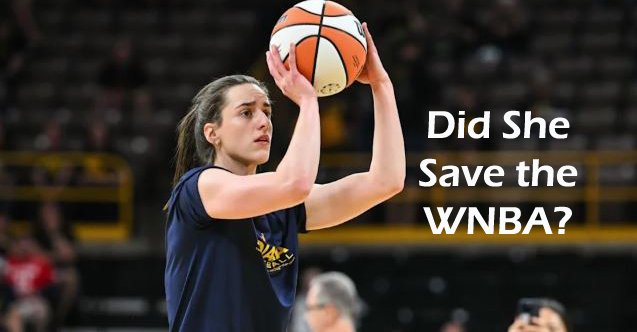
In boxing there was once a fighter known as the Great White Hope. Now, were I to label Caitlin Clark as the WNBA’s “Great White Hope,” I would be labeled in various ways, certainly as a racist, a white supremacist, a far-right extremist, a Nazi, a Fascist, Herman Goering, you name it.
All that aside, you can’t ignore the fact that once women’s basketball phenom Caitlin Clark — she being white — left college and joined the Women’s National Basketball Association (WNBA), the league’s viewership and game attendance both skyrocketed. In fact, ESPN telecasts of the NBA — the all-male version of professional basketball — and the WNBA are now neck and neck.
The WNBA was pretty much a sideshow to the “real deal” in the men’s version since its inception under then-Commissioner David Stern. NBA teams would field WNBA counterparts, and then write them off on their taxes. Salaries rarely went above $50,000 a year. Players would have to take commercial flights, not private jets like their male counterparts.
Now, post-Clark, WNBA players are not only flying on private jets, but are now eyeing a proposed players’ contract that amps up salaries and benefits big time.
“This Collective Bargaining Agreement represents a defining moment in the WNBA’s 30-year history and all of women’s professional sports,” said WNBA Commissioner Cathy Engelbert. “Since its inception, the WNBA has been shaped by extraordinary athletes who believed in the league’s future. The agreement is a testament to that belief and to the tremendous progress we have achieved together.”
Each team’s salary cap will increase nearly fivefold to $5.75 billion initially and then to $8.5 billion in year six. The deal would result in maximum salaries increasing by more than $1 million — from $249,000 to $1.3 million — and average salaries increasing from $120,000 to $540,000 in the first year.
Now, if something happened other than the appearance of Ms. Clark to make all this suddenly happen, please let me know what it was.