Okay, the obvious reason for the conflict is a decision made by Donald Trump as Commander-in-Chief of the U.S. armed forces to bomb Iran. However, as matters stood at the beginning of 2026, Iran was facing a massive regime-change uprising, Israel was locked and loaded against its mortal enemy, the Islamic Republic, and the U.S. had just concluded an unimaginably successful military operation in Venezuela called Operation Absolute Resolve.
The Iran uprising prompted President Trump to vow that “help is on its way,” but no help was forthcoming while at least 30,000 Iranian protestors were slaughtered by the regime. Meanwhile, the foray into Venezuela on January 3 to extract Nicolás Maduro under Absolute Resolve left that country in the hands of a Trump puppet named Delcy Rodriguez, formerly vice president under Maduro. Israel under Benjamin “Bibi” Netanyahu was locked in a struggle with Iran over its nuclear weapons and missile programs. He wanted both programs eliminated — and probably the entire country as well.
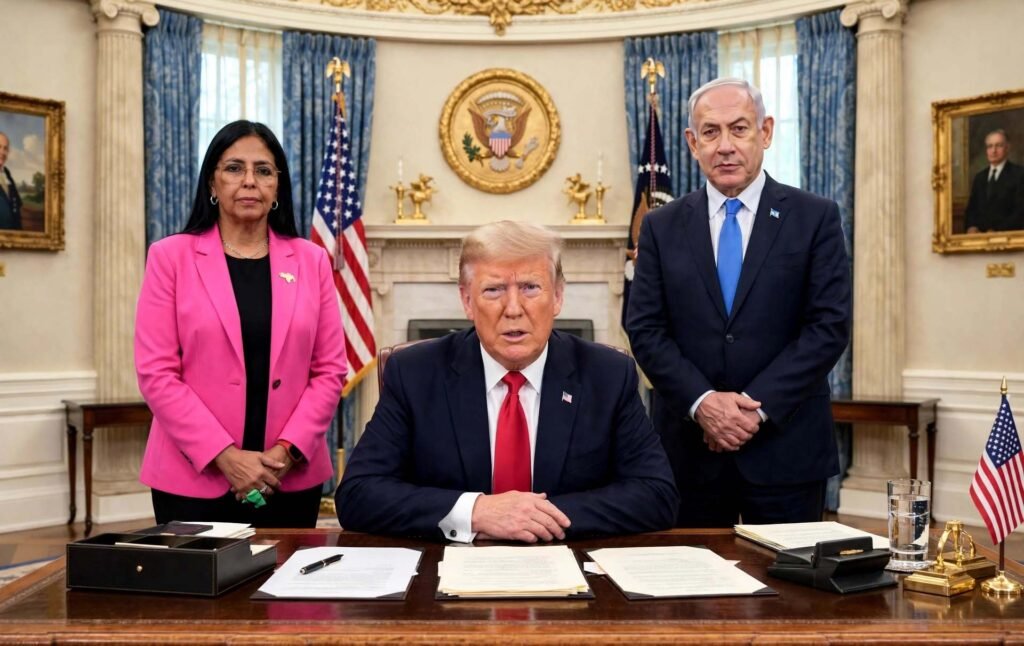
Netanyahu took his concerns to Trump both at the end of 2025 and the beginning of 2026, and the two remained in constant contact. When Venezuela was overwhelmed by U.S. forces so quickly and almost effortlessly, Trump was ecstatic at how easy it was. He was also ecstatic that Ms. Rodriguez was now in charge and willing to do his bidding, so long as she could remain in power.
The wheels started churning in Trump’s brain. “I promised Iranians help,” he remembered, and he weighed that help in the light of Venezuela and how easy it had been to effect regime change, and basically to be in charge of the country. “Why not Iran?” he pondered. “In two or three days, we can have a new leader like Delcy, and I can have Iran’s oil as I now have Venezuela’s.” Bingo! “Let me call Bibi and get things rolling.”
Thus began Operation Epic Fury on February 28, 2026.
At the beginning of the campaign, Trump sent a public message to the people of Iran: “When we are finished, take over your government. It will be yours to take… I call upon all Iranian patriots who yearn for freedom to seize this moment, to be brave, be bold, be heroic, and take back your country.” In other words, regime change — and the fulfillment of his earlier “help is on the way” pledge — took center stage when bombs away began.
Answering reporters’ questions on Day One of the war, Trump said the campaign should take only two or three days. In his mind, in other words, he figured he could find a Delcy-style turncoat to take over the country and operate it on his terms. It’s now almost half a year later, and no such Quisling has appeared. In fact, the reverse has happened. The country is now ruled by extreme commanders in the Islamic Revolutionary Guard Corps (IRGC).
Those “two or three days” stretched into almost two months. When his 60-day limit under the War Powers Act approached, Trump called for a ceasefire. Iranians, under the IRGC, then took control of the Strait of Hormuz — and still hold it to this day under threat of ship bombings. On June 17, with a global recession on the horizon due to oil price shock from the war, Trump signed a memorandum of understanding (MOU) with Iran. The deal included opening of the Strait of Hormuz for 60 days while negotations toward a long-term deal could be reached.
The IRGC said “nyet” to the deal and start firing on ships trying to cross through the Strait without its permission, in other words, on those vessels using the American-controlled passage in waters off Oman. Trump announced the MOU — and then the ceasefire itself — were null and voice on July 8. In response to IRGC attacks on vessels in the Strait, the U.S. started firing back — supposedly only on weapons and installations that could threaten shipping lanes. In a few days, the scope of operations began to include bridges and highways leading to the IRGC-controlled ship monitoring sites.