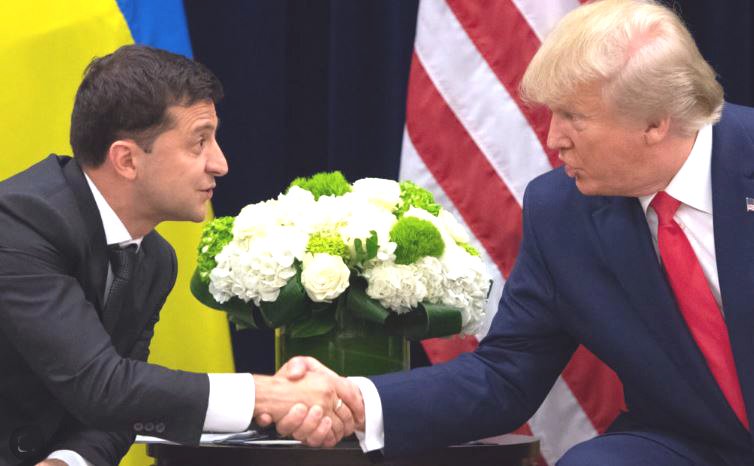
Once again, the Wall Street Journal has buried the lead on an article titled “Trump Pushes Ukraine to Accept Peace Deal, Saying It Is Losing.” While the headline conveys important information, to me as a trained journalist, the meat of the article — what we would traditionally call the lead — isn’t revealed until the sixth paragraph.
In that graf (to use journalist speak), the WSJ finally reveals that Zelenskyy won’t sign on until he gets stronger security guarantees, or as he put it in his own words, something that is more than “empty promises, but legally binding, voted through the U.S. Congress.”
The U.S. Congress, in other words, must legally bind the government to defending Ukraine in any post-Russian-invasion future before Zelenskyy will accept any deal.
The article also reveals that European leaders, who side with the Ukrainian president, are drafting a counter-proposal that features such U.S. guarantees and that respects Ukrainian territorial and political rights more fully.
Burying the lead, as we journalists call it, seemed to become fashionable in the 1970s and 1980s when, facing declining readership (subscribers, in other words), newspapers revamped their approach to reporting the news, turning to a more feature article-like structure.
Gone were the five W’s and an H — who, what, when, where, why, and how — that I was taught should comprise the first paragraph of a news article.
At any rate, European leaders are cautioning Trump to slow down the drive for an accord, saying the process could take many more months. There goes that Nobel Peace Prize Trump was hoping to win early next year.
Oh, well, the prize committee would probably give the award to Zelenskyy anyway.